Hedge Fence Extensions
Artificial hedge fixed to the face of the fence you already have, rising above it. More height, no rebuild.
Material, from $65 per linear ft
For a 3 ft extension, foliage on one side + installation, priced to your site Both sides costs more; priced to your site.
Run elevation Illustrative, not to a survey
A 6 ft wood fence, raised 3 ft: 9 ft of total height.
Both sides is priced to your site. One side starts from $65 per linear ft for a 3 ft extension, material.
Height additions can need local review: your city and any HOA set the limit, and we will tell you what to ask them before final scope.
3 ft is the priced height, with foliage on one side. Taller or shorter is priced by height from the 3 ft rate. Or drag the line on the drawing.
One side or both.
Both sides is the standard build: hedge on each face of the frame, the same from your side and the other. One side saves cost, and it is the build the starting price is for.
Sections A and B through your 6 ft wood fence, raised 3 ft in Boxwood, at one scale. Illustrative: the frame, generally steel square tube, is fixed to the face of your fence and comes 1 ft 6 in down it, 1 ft for every 2 ft of extension height; the depth of the foliage is drawn as typical, and the ringed joint is detailed under How it’s built.
Installation is priced to your site:
Confirmed at a free, no-obligation site visit in Southern California. Then production and install, after hours or overnight when access and size allow.
Height without rebuilding.
Hedges mounted on the block wall and metal railing already there, in Downtown Los Angeles. No new wall, no structural changes.
Marked: this job matches your drawing.
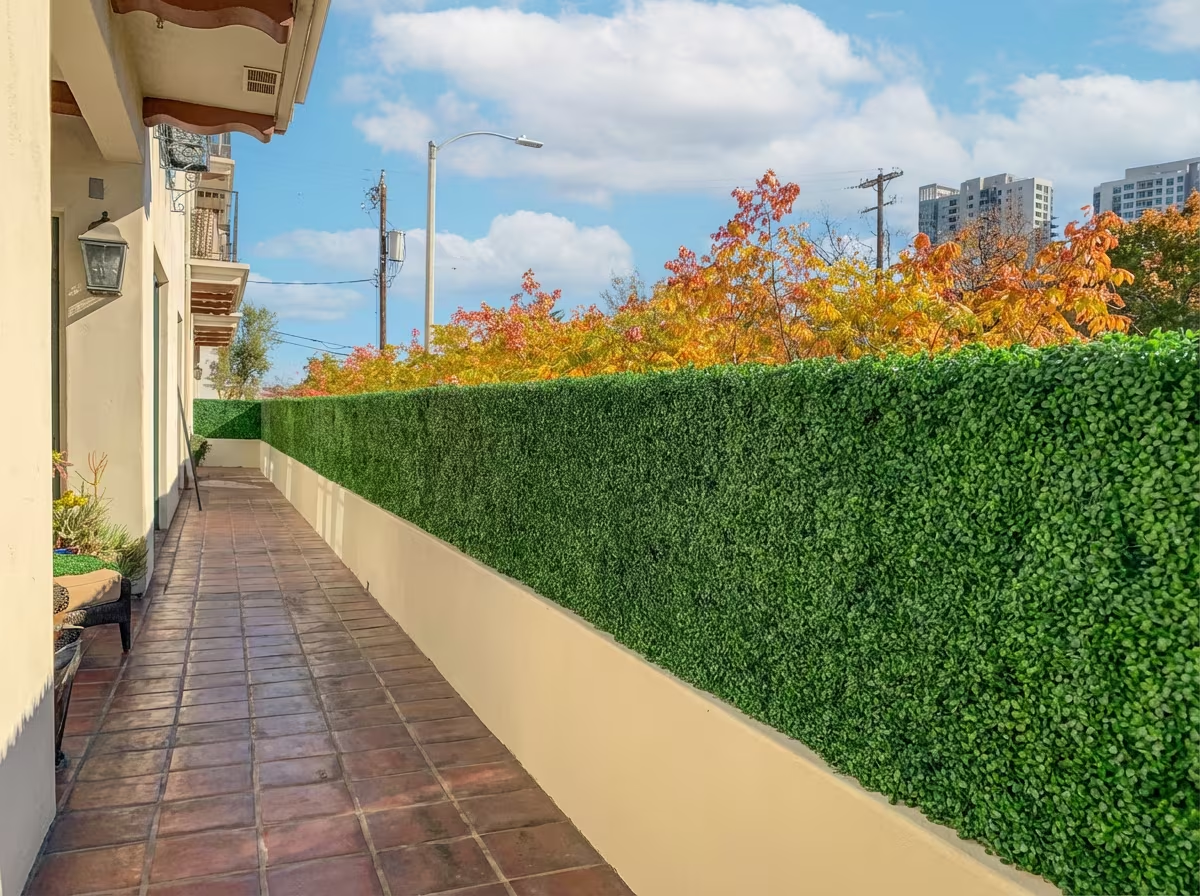 From the patioBuilt with Boxwood
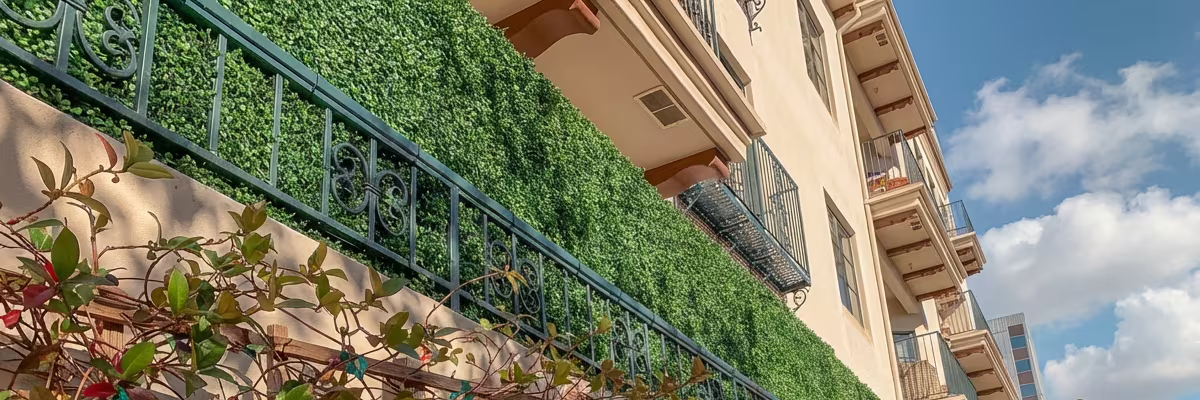 From the street
A hedge fence extension on a Downtown LA block wall
- Place
- Los Angeles
- Mounted on
- The block wall and metal railing already there
- Material
- Artificial boxwood
- Install
- Two weeks
- Year
- 2019
The same hedge, mounted other ways
Privacy hedges, not extensions: around a deck and jacuzzi, along a hillside deck, and on a rooftop.
- Brentwood backyard jacuzziBrentwood · 2020: Artificial boxwood hedges for backyard privacy in Brentwood, CA
- Brentwood hillside deckBrentwood · 600 sq ft · 2019: Brentwood privacy hedge installation: 600 sq ft of UV-resistant artificial hedges
- LA Golf rooftopLos Angeles · 300 sq ft · 2023: LA Golf rooftop: 300 sq ft of artificial hedges to hide AC units and add privacy
- The artificial privacy hedge
How it’s built.
A fence extension is an added screening system used to increase privacy above an existing fence line without replacing the full fence assembly.
The mat
One of the nine foliage mats in the library above. Standard foliage is UV-stabilized for outdoor sun. Fire-rated foliage (NFPA 701) is an upgrade at extra cost, with documentation on request. Lightweight foliage systems to support retrofit conditions.
On a frame
UV-stabilized foliage panels on a frame, generally steel square tube, fixed to the face of the fence. Both sides as standard; one side to save cost.
On your fence
It attaches to the face of your fence or wall, generally with steel square tube, and comes down 1 ft for every 2 ft of extension height, so a 3 ft extension overlaps the fence by 1.5 ft; the foliage covers the tube at the bottom. Installation paths for wood and metal fences, and select masonry walls, after the fence is reviewed; extending a vinyl fence is much harder and generally not recommended. Foliage panels retrofit onto existing fence lines for added coverage.
What we check first
- Wood (your fence)
- Post depth, post spacing, and any rot at the base.
- Vinyl
- Extending a vinyl fence is much harder and generally not recommended: its hollow posts and connections were made for the original height.
- Metal
- The spacing between rails, the gauge of the metal, and any rust.
- Block wall
- The cap, the total height against local limits, and the face the square tube fixes to, so the wall stays sound.
Existing post condition and attachment points should be confirmed before ordering materials. Exposure to coastal wind corridors can affect reinforcement approach.
From the site visit to closeout
- Fence condition review and measurement
- Attachment layout and design signoff
- Material prep and scheduling
- Install, alignment, and closure detailing
- Foliage matBoxwood, UV-stabilized
- FrameSteel square tube, generally
- AttachmentOn the face of your fence, 1 ft 6 in down it
- Your fenceWood, 6 ft
Check the height first.
California has no single statewide fence height limit. Yours is set where the fence stands, by three layers of rules.
Your city or county
Its zoning code sets the limit, by zone and by yard: front, side and rear. Most cities count an extension toward it, as they would a new fence; some classify hedge panels differently. Going over it can need a permit or a variance, and the state building code exempts only fences up to 7 ft from a building permit, so a taller one usually needs one.
Your HOA, if you have one
Its CC&Rs can ask for less height, set materials and colors, or require architectural review before work begins. It can make the limit stricter, never looser.
Your neighbor
State law presumes neighbors share the reasonable costs of a shared boundary fence, subject to exceptions (Civil Code § 841), and makes a fence over 10 ft kept up to annoy a neighbor a private nuisance (§ 841.4). Some cities allow more height with a neighbor’s agreement or a variance.
Your city and any HOA set the limit. At the site visit (free, in Southern California) we will tell you what to ask them before final scope, and we suggest a call to your city’s planning department: many have a duty planner who can confirm the fence rules for an address.
The spec sheet.
| Material | UV-stabilized foliage panels on a frame, generally steel square tube, fixed to the face of the fence Lightweight foliage systems to support retrofit conditions |
|---|---|
| Foliage | Nine mats: Oasis, Boxwood, Ficus, Succulent, Fern, Vallum FRX, Moss, Lush Long Leaf, Dragon Leaf Geranium Street lookbook FM.2026. Oasis and Vallum FRX are premium; Oasis is the signature mat. More foliage is available on request; fire documentation depends on the product. |
| Foliage faces | Both sides as standard; one side to save cost. The starting price is for one side. Both sides costs more, priced to your site. |
| UV | UV-stabilized as standard, every mat in this library |
| Fire | Fire-rated foliage (NFPA 701) is an upgrade at extra cost Standard foliage is UV-stabilized, not fire-rated. The documentation is available on request. |
| Extension height | 3 ft, the priced configuration, with foliage on one side. Common extension ranges are selected to match existing fence geometry and code context |
| Existing fences | Wood and metal fences, and select masonry walls Extending a vinyl fence is much harder and generally not recommended. Existing post condition and attachment points should be confirmed before ordering materials. |
| Attachment | Fixed to the face of the fence or wall, generally with steel square tube, covered by the foliage at the bottom Final detailing is confirmed after the fence has been reviewed in the field. |
| Overlap | 1 ft down the face of the fence for every 2 ft of extension height: 1.5 ft on the 3 ft extension |
| Wind | Exposure to coastal wind corridors can affect reinforcement approach. |
| Local review | Height additions may require local review depending on jurisdiction and parcel conditions. |
| Expected outdoor life | 5–7+ years Geranium Street lookbook. Long-term results depend on substrate condition and site exposure. |
| Warranty | 3–5 year limited UV fading warranty (varies by product line) on qualifying systems Coverage is limited and subject to product eligibility and installation scope; ask us what it covers before you buy. |
| Water and care | No irrigation, no trimming. Upkeep is typically periodic inspection and cleaning. Adds visual coverage to an existing fence without irrigation infrastructure. Often easier to maintain than live vine or hedge growth on a fence line. |
| Material price | From $65 per linear ft, 3 ft extension, foliage on one side + installation, priced to your site. Made to order with full customer input. Prices are for standard UV-stabilized foliage; fire-rated foliage costs extra. |
How fence extensions fit California property lines
A fence extension adds hedge above the fence you already have, fixed to its face, for more height without a rebuild. The starting price is for a 3 ft extension with foliage on one side; both sides, the standard build, is priced to your site.
Whether it works depends on the fence: its condition, its posts and what it is made of are reviewed first, and a fence that is failing is a case for replacement, not an extension. Extending a vinyl fence is much harder and generally not recommended. Height limits vary by city and HOA; we will tell you what to ask them before final scope.
California Civil Code § 841 presumes that neighbors share equally in the reasonable costs of a fence dividing their properties, unless they agree otherwise in writing. On a shared boundary fence, talk to your neighbor before you raise it. Source: California Civil Code § 841
UV-stabilized polyethylene foliage, the same mats as every system, on a frame, generally steel square tube, fixed to the face of the existing fence and coming down it 1 ft for every 2 ft of extension height, the foliage covering the tube at the bottom. Fire-rated foliage (NFPA 701) is an upgrade at extra cost, with documentation on request.
Common questions.
Can you add height to my existing fence?
It can, if the fence is sound. The extension attaches to the face of your fence or wall, generally with steel square tube, and comes down 1 ft for every 2 ft of extension height, so a 3 ft extension overlaps the fence by 1.5 ft. After we review the fence's condition, an extension can add height to wood and metal fences, and select masonry walls. Extending a vinyl fence is much harder and generally not recommended.
Do they need a permit?
Permit requirements vary by jurisdiction, property condition, location on the parcel, and final height. Many projects start with local height-limit review before final scope is confirmed.
How long does installation take?
Installation timing depends on the fence condition, linear footage, and access. Final timing is confirmed after site review.
Who provides the installation?
Califauxscapes is the California installation division of Geranium Street USA, Inc. Installation services are provided by Geranium Street USA, Inc., CSLB #955154.
How does it attach to my fence?
It attaches to the face of your fence or wall, generally with steel square tube, and comes down 1 ft for every 2 ft of extension height, so a 3 ft extension overlaps the fence by 1.5 ft; the foliage covers the tube at the bottom. Final detailing is confirmed after the fence has been reviewed in the field.
Send us your fence.
Tell us what it is made of, how tall it stands and how long the run is. Photos of the fence and its posts help; add them here or we’ll ask. We review its condition before the extension is fixed to its face.
(760) 978-7335- A quick callAbout your wall and what it needs to hide.
- Online site reviewA render on your photo, with an intro estimate.
- Free site visitIn Southern California, for the final estimate. No obligation.
Straight answers.
Add privacy height to an existing fence without a full rebuild.
Artificial fence extension installation for California properties where an existing fence line needs more privacy height, cleaner screening, or a finished hedge-style edge.
Fence extension installations are a strong fit when an existing fence is still serviceable but needs more privacy height, better screening, or a cleaner finished edge. The extension attaches to the face of the fence, generally with steel square tube, and Califauxscapes reviews fence condition, wind load, and local height limits before recommending it for side yards, pool areas, multifamily boundaries, and other privacy-driven projects.
When it makes sense
Usually fits
- Retrofit privacy upgrades on existing fence lines
- Backyards and side yards with direct sightline issues
- Projects that need more coverage without a full rebuild
Common use cases
- Side-yard sightline control
- Pool and spa privacy upgrades
- Multi-family perimeter enhancements
Benefits
- Can raise privacy without replacing the full fence line
- Can reduce project disruption compared with full demolition
- Supports staged upgrades for larger properties
- Can modernize older boundaries with a cleaner design language
- Usually simplifies ongoing upkeep compared with live vines
What to plan for
- Existing post condition and attachment points should be confirmed before ordering materials.
- Height additions may require local review depending on jurisdiction and parcel conditions.
- Exposure to coastal wind corridors can affect reinforcement approach.
Common installation conditions
Review how this system fits the substrate, the privacy requirement, the desired finish, and the maintenance expectations for the property.
- Privacy contribution
- Strong uplift when paired with proper height strategy.
- Architectural impact
- Finish detailing drives visual quality.
- Maintenance simplicity
- Upkeep is typically periodic inspection and cleaning.
- Retrofit flexibility
- Frequently selected for existing fence retrofits.
Limited warranty terms apply and require approved installation conditions.
When it’s not the first recommendation
- It depends on the condition and suitability of the existing fence.
- It is not the right fit when the base fence is failing or the required height exceeds what the site can reasonably support.
Extend an existing fence for privacy
A privacy fence extension typically makes sense when the existing fence is straight, stable, and worth keeping, but the sightline over the top is still exposed. In those cases, a retrofit can add screening height without demolition, new posts, or a full fence replacement. The released material price is for a 3 ft extension with foliage on one side; other heights depend on the existing fence and local limits. The extension attaches to the face of the fence or wall, generally with steel square tube, and comes down 1 ft for every 2 ft of extension height, so a 3 ft extension overlaps the fence by 1.5 ft, the foliage covering the tube at the bottom. Extending a vinyl fence is much harder and generally not recommended. Replacement is usually the better recommendation when posts are loose, rails are failing, rot is present, or the requested height would overload the existing structure. Wind load matters, especially on corner lots, rooftops, coastal corridors, and long uninterrupted fence runs. Before quoting, Califauxscapes reviews the face and posts of the fence, its material, post spacing, exposure, access, and the likely reinforcement path.
Califauxscapes serves Los Angeles County, San Diego County, Orange County, the San Francisco Bay Area, and the Inland Empire.
Weighing a retrofit against lattice, metal, or a full rebuild? Our guide can help you compare fence extension options before you commit.
Where it fits.
Fence extensions fit best when the existing fence is still worth keeping but the property needs more privacy height or a cleaner visual edge. They are a practical retrofit move for side yards, backyards, pool areas, and multifamily boundaries where a full rebuild is not the right first step.
California service areas
Califauxscapes reviews this installation type across priority California markets. Califauxscapes currently focuses on Southern California, the Bay Area, and the Inland Empire.
- San Diego County artificial greenery installationCoastal backyards and side yards that need more screening on an existing fence.
- Los Angeles County artificial greenery installationRetrofit privacy upgrades for homes and multifamily properties with existing fence lines.
- Orange County artificial hedge installationHOA-aware residential and hospitality edges that need added height without a rebuild.
- Bay Area artificial living wall installation
- Inland Empire artificial fence extension installationLarger lots and hotter exposures where broad privacy coverage is the priority.
Related systems
- Artificial Living WallLayered vertical panel systems for interiors and exterior feature zonesCompare artificial living wall installation
- Privacy WallFreestanding, fully custom screening walls built for controlled sightlinesCompare privacy wall installation
- Artificial Privacy HedgeBoxwood-style and mixed-texture hedge systems for premium screeningCompare artificial privacy hedge installation
- All four, side by side
Just need panels? Buy artificial hedge panels from Geranium Street
Guides to read next
- Fence Extension Options ComparedA side-by-side guide for retrofit height, attachment, and finish options.
- California Fence Height Laws & PrivacyUseful when local height rules or visibility constraints shape the scope.
- Fire-Rated (NFPA 701) Artificial PlantsWhen fire marshals ask for it, and how NFPA 701 Method 2 testing works for artificial greenery.
Related project
Compare next steps
Califauxscapes is the California installation division of Geranium Street USA, Inc. Installation services are provided by Geranium Street USA, Inc., CSLB #955154.
Califauxscapes
Custom artificial living walls and hedges, designed with you and installed across California.