Artificial landscaping guides
Six questions buyers ask before choosing a system, each answered in one line, then in full, with the jobs behind it.
- Guides
- 14
- Questions
- 6
- Focus
- California-focused
- Latest update
- Written by
- Alex Tarnowski
What will it cost?
The released starting prices, what moves them, and how to budget before a site review.
California artificial landscaping cost guide
How to budget with real site variables instead of generic square-foot promises.
In one line Budget the material from the released starting prices, then let the site visit price the installation: access, substrate and attachment, and run length move it.
What it covers 5 sections
The material starting prices for all four systems, what moves the installed number, when to phase, and what warranty and upkeep add to the cost of owning it.
Artificial or living?
Where each one earns its place, with the trade-offs said plainly.
Artificial hedges vs. natural hedges
Start with what the hedge has to do, then weigh water, upkeep and how each looks over time.
In one line Artificial where privacy has to work now without irrigation, natural where water and upkeep are assured, and often both, zone by zone.
What it covers 4 sections
Water use, maintenance, design control and long-term ownership, compared, so you can decide where an artificial hedge, a natural one or a mix of both fits the site.
The best privacy hedges for Southern California: living and artificial options compared
Ficus, podocarpus, privet, bamboo, and artificial hedge systems: what actually performs in SoCal heat, drought rules, and coastal exposure.
In one line Fast living screens such as ficus can fill in within a few seasons from good-sized plants; for any hedge, size, spacing and conditions set the time. An installed artificial hedge is full on installation day and uses no water.
What it covers 5 sections
The best privacy hedge for Southern California depends on the site: ficus and privet are fast but thirsty and high-maintenance, podocarpus and Carolina cherry are cleaner but take time to fill in, bamboo fits narrow planters, and installed artificial hedge systems deliver full-density screening on installation day with zero irrigation, the strongest fit for deadlines, restricted water, rooftops, and guest-facing commercial edges.
Artificial living wall vs. real living wall
Choose the wall the property can keep up: a planting program, or a finished surface.
In one line A real living wall needs a plant operations program for as long as it stands; an artificial one trades ecology for control, speed and no irrigation.
What it covers 3 sections
What a real living wall’s plant program involves, why artificial walls are chosen for control and speed, and how to choose by the upkeep the property can sustain.
Artificial vs. preserved moss walls
They look different, need different rooms and are kept differently: choose by the room you have.
In one line Preserved moss suits controlled interiors, roughly 35–65% humidity depending on the maker; artificial foliage gives more depth and tolerates less predictable rooms.
What it covers 3 sections
How the two read in a space, which rooms each one tolerates, and how each is kept after handoff.



Which way to privacy?
What your fence can carry, where you are seen from, and the screens that answer it.
How to extend fence height for privacy
Raise the fence you have or replace it: what to check first.
In one line If the fence is sound, an extension adds height without a rebuild; check its condition, the attachment, wind and the local height limit first.
What it covers 3 sections
Four ways to more privacy at a boundary, chosen by what is on site now, and the one case where more height is the wrong fix: a fence that is already failing.
Pool and patio privacy in California: how to choose the right screening approach
Start from where you are seen, then match the screen to the fence, the pool rules, wind and sun.
In one line Screen the sightline you are exposed to, not the whole perimeter; pool barrier rules are separate from fence height rules, so check both.
What it covers 5 sections
Natural planting, fence extensions, freestanding walls, artificial hedge panels and lattice with vine, each matched to the conditions it suits, with where each falls short.
What do the rules allow?
Fence heights, water and fire review: where each rule comes from and who to ask.
California fence height rules and privacy: what to check before you build
Where to find your local height limits, setback rules, and HOA restrictions before planning a privacy upgrade.
In one line There is no statewide limit: your city or county zoning code sets it, often 6 ft at the rear and interior sides and 3–3.5 ft in front, and an HOA can only make it stricter.
What it covers 5 sections
Where fence height rules come from (state law, the city or county zoning code, the HOA), the common limits, how to look up yours, where extensions and privacy screens fit, and how to check a contractor’s CSLB license.
Artificial landscaping and California water restrictions: what property owners should know
How water policy, drought restrictions, and landscape ordinances connect to artificial landscaping decisions.
In one line Artificial zones need no irrigation and sit outside the MWELO water budget; drought-tolerant natives are the better answer wherever living material can thrive.
What it covers 5 sections
How drought restrictions, tiered pricing and MWELO shape what you can plant and what it costs to water, where artificial landscaping fits, and when drought-tolerant natives are the better answer.
NFPA 701 Method 2 explained: fire-rated artificial plants for California businesses
What the test actually measures, where California businesses get asked for it, and how to specify fire-retardant artificial hedges and living walls with the documentation reviewers ask for.
In one line Method 2 is the flame test usually cited for foliage, and the code accepts Method 1 or 2 as appropriate, or NFPA 289; our standard foliage is UV-stabilized, fire-rated foliage is an upgrade at extra cost, and the local fire authority makes the final call.
What it covers 4 sections
NFPA 701 Method 2 is the flame-propagation test usually cited for artificial foliage. Passing means the material self-extinguishes rather than spreading flame: fire-retardant, never “fireproof.” California businesses typically need product-specific test reports for artificial greenery in hotels, restaurants, casinos, offices, and multifamily common areas, with the local fire authority making the final call.

How is a project planned?
Scoping living walls, commercial sites and walls that keep getting tagged, before anything is ordered.
Complete guide to artificial living walls
Where an artificial living wall earns its place, and what to settle before you order one.
In one line They earn their place where a wall must stay composed all year without irrigation; resolve the substrate, edges and access before procurement.
What it covers 4 sections
Where artificial living walls perform best, what sets the finished quality, how the substrate and access shape the scope, and what upkeep to expect after installation.
How to plan commercial artificial landscaping, zone by zone
How commercial teams scope visible landscape upgrades without creating operational drag.
In one line Plan by zone, stage the install around operations, and write down who maintains what before sign-off.
What it covers 3 sections
Zone planning, installation sequencing on a site that stays open, and the maintenance assumptions to put in writing before sign-off.
Graffiti abatement using artificial foliage in California
How modular screening systems change the maintenance equation for walls, fences, and enclosures that keep getting tagged.
In one line Foliage does not stop tagging; modular panels let you clean or replace one section instead of repainting a whole wall.
What it covers 13 sections
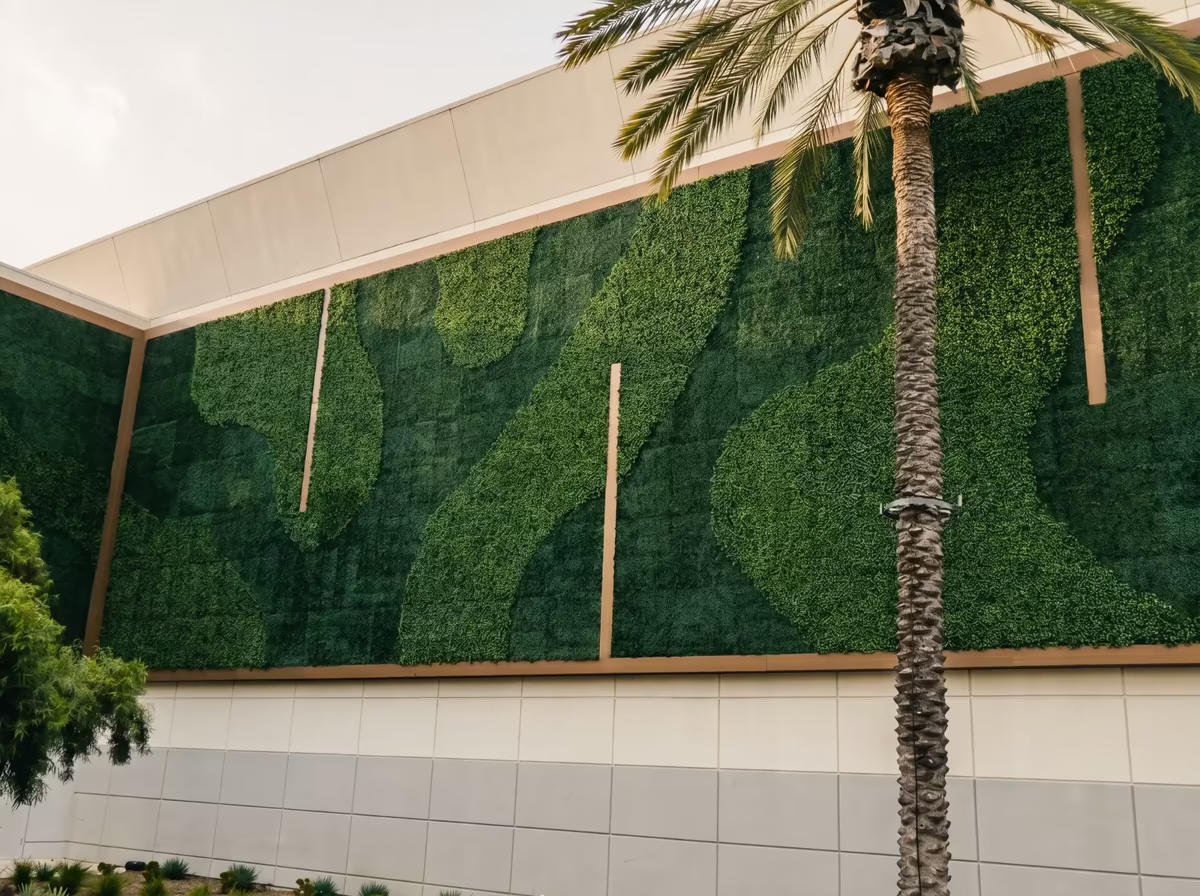
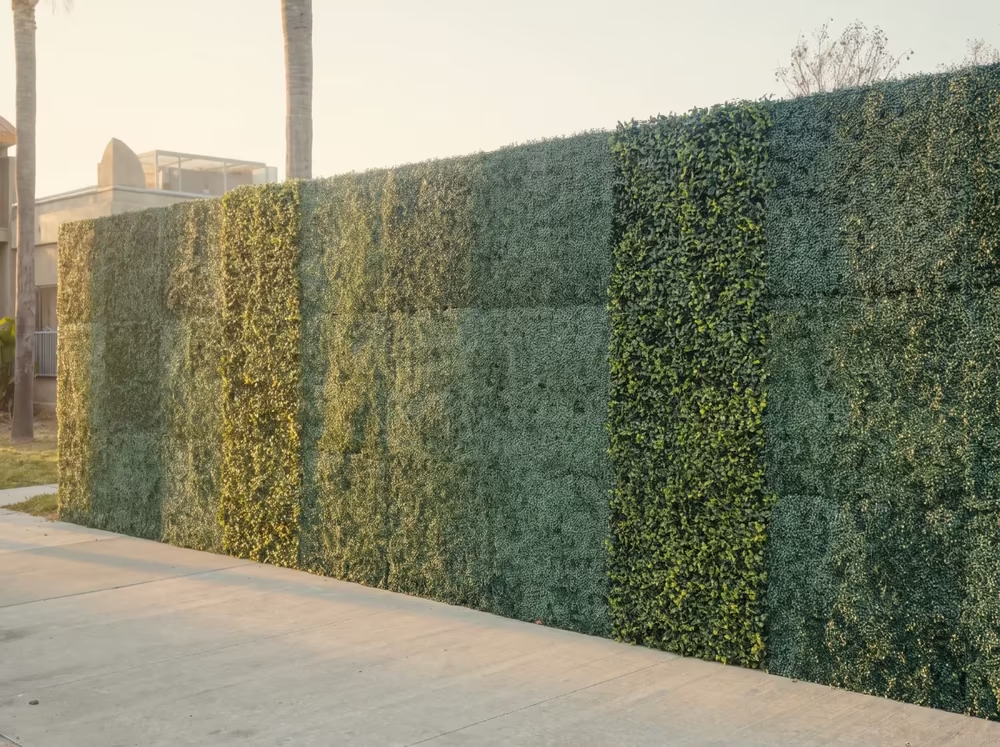
Why repainting keeps a tagged wall a target, how modular panels change the fix, what foliage screening does and does not do, where it fits and where it does not, the fire code and climate questions, and the 1,500 sq ft Compton wall.
- How much does graffiti actually cost California properties?
- Why does repainting make the problem worse?
- Why does removal speed matter so much?
- What is recovery architecture?
- What does foliage screening actually do?
- How does the Califauxscapes modular system work?
- Where does modular screening fit best?
- Where is this not the answer?
- What does the evidence actually support?
- How does artificial foliage compare ecologically to living plants?
- What are the fire code requirements in California?
- What does California’s climate mean for exterior installations?
- The Compton project: what a real installation looks like

How do you care for it?
Realistic upkeep, set by exposure and written down before handoff.
Artificial landscape maintenance and care guide
What realistic upkeep looks like when the finish quality still matters.
In one line Lower maintenance, not none: clean as dust and debris build up, more often near a road, the coast or trees, and inspect the edges and fasteners.
What it covers 3 sections
How often to clean by exposure, what to inspect (the attachment, the edges, local wear) and when professional service is worth it, for living walls, privacy hedges and privacy walls.
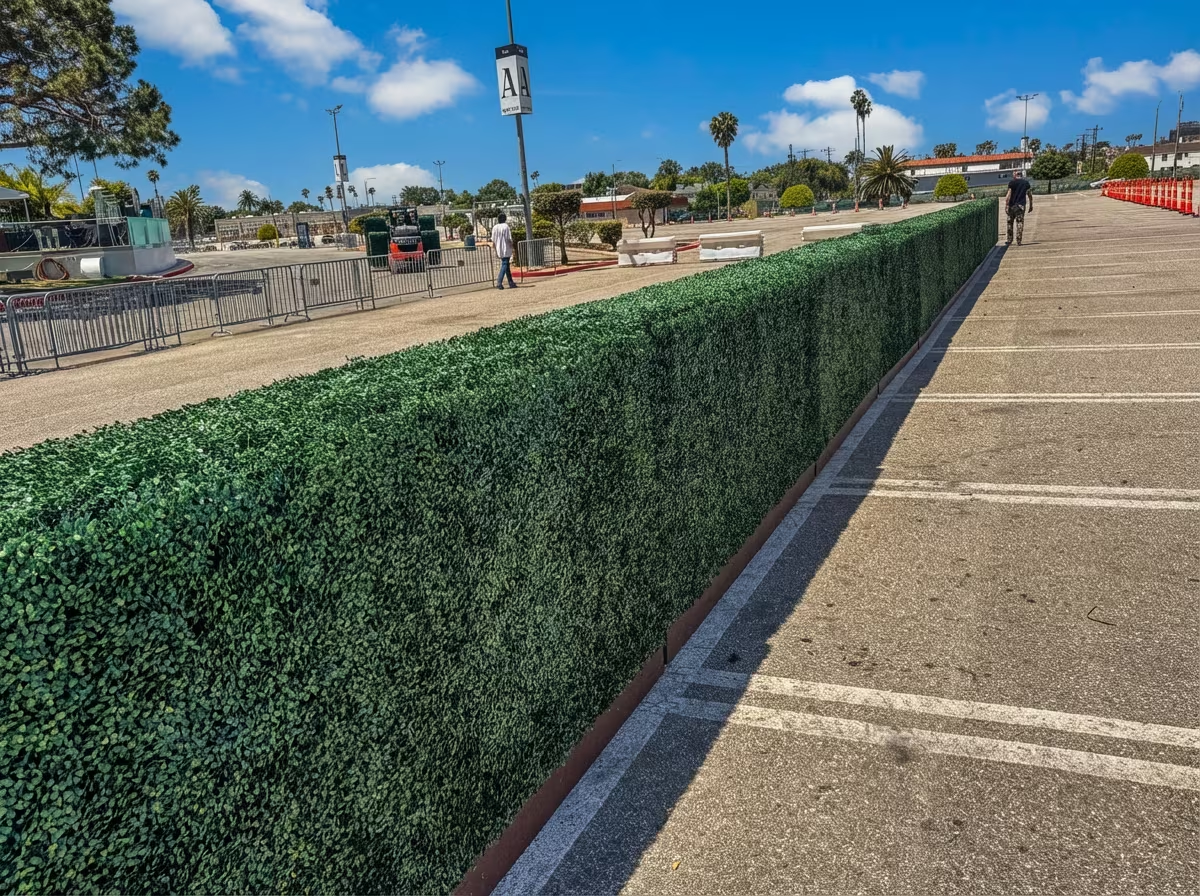
Not sure which guide fits your wall? Send us a photo. The online site review returns a render on your photo with an intro estimate, and we tell you straight what is possible.
Bring us the question.
Cost, fence height, water, fire rating or upkeep: tell us what you are weighing and where the wall is. Photos help; add them here or we’ll ask. We reply with next steps and a straight answer for your site.
(760) 978-7335- A quick callAbout your wall and what it needs to hide.
- Online site reviewA render on your photo, with an intro estimate.
- Free site visitIn Southern California, for the final estimate. No obligation.
The terms behind the work.
Limited warranty on UV fading and installation workmanship
3–5 year limited UV fading warranty (varies by product line) on qualifying products and 1-year installation workmanship warranty.
Coverage is limited and subject to product eligibility and installation scope; ask us what it covers before you buy.
Expected outdoor life
5–7+ years for the mats (Geranium Street lookbook FM.2026). That is not a warranty term.
Topics in the library
Califauxscapes
Custom artificial living walls and hedges, designed with you and installed across California.