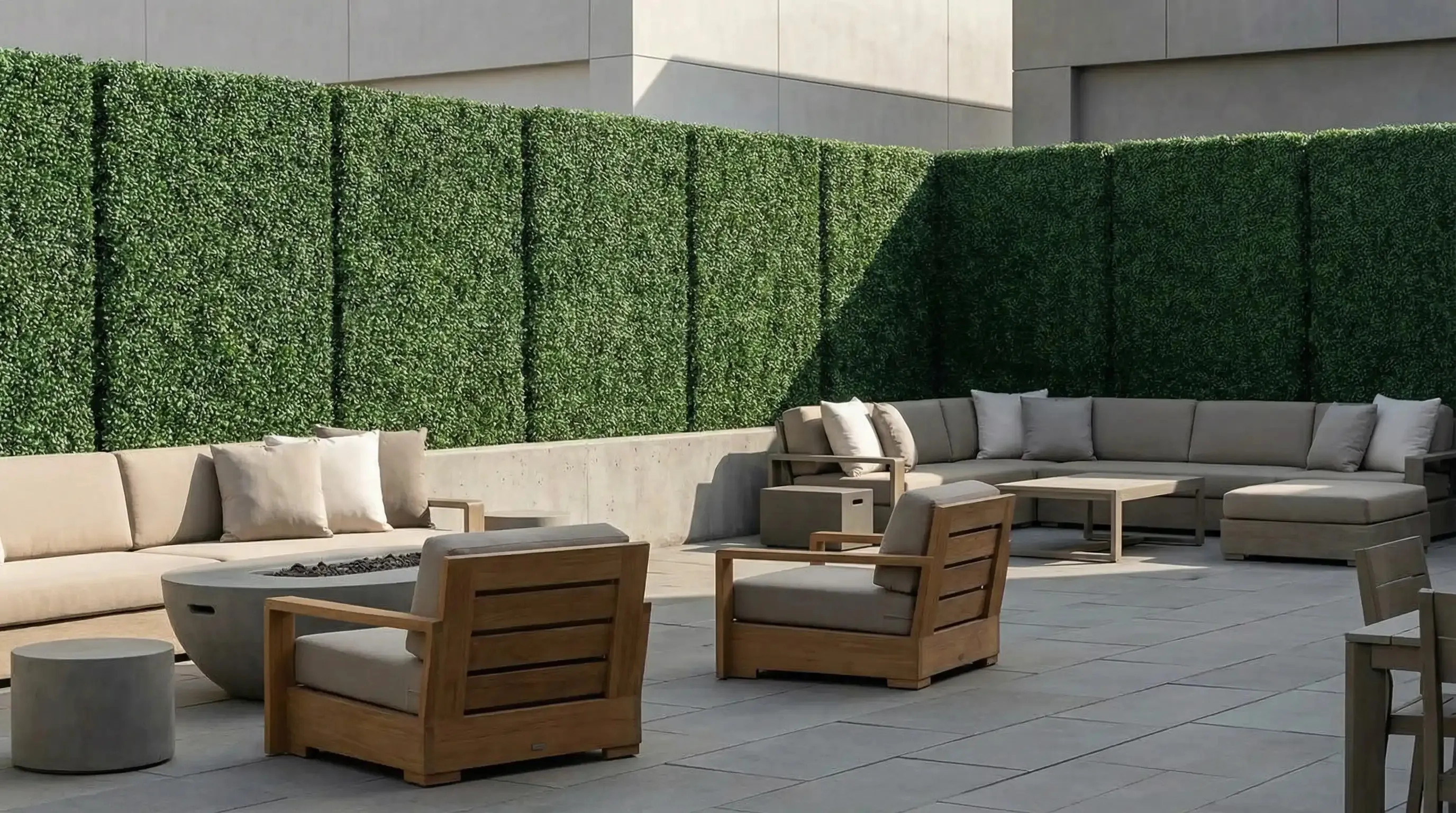
Challenge profile
What this scope is usually trying to solve
Enclosed courtyards can feel flat or underutilized when vegetation planning is constrained by access and maintenance logistics.
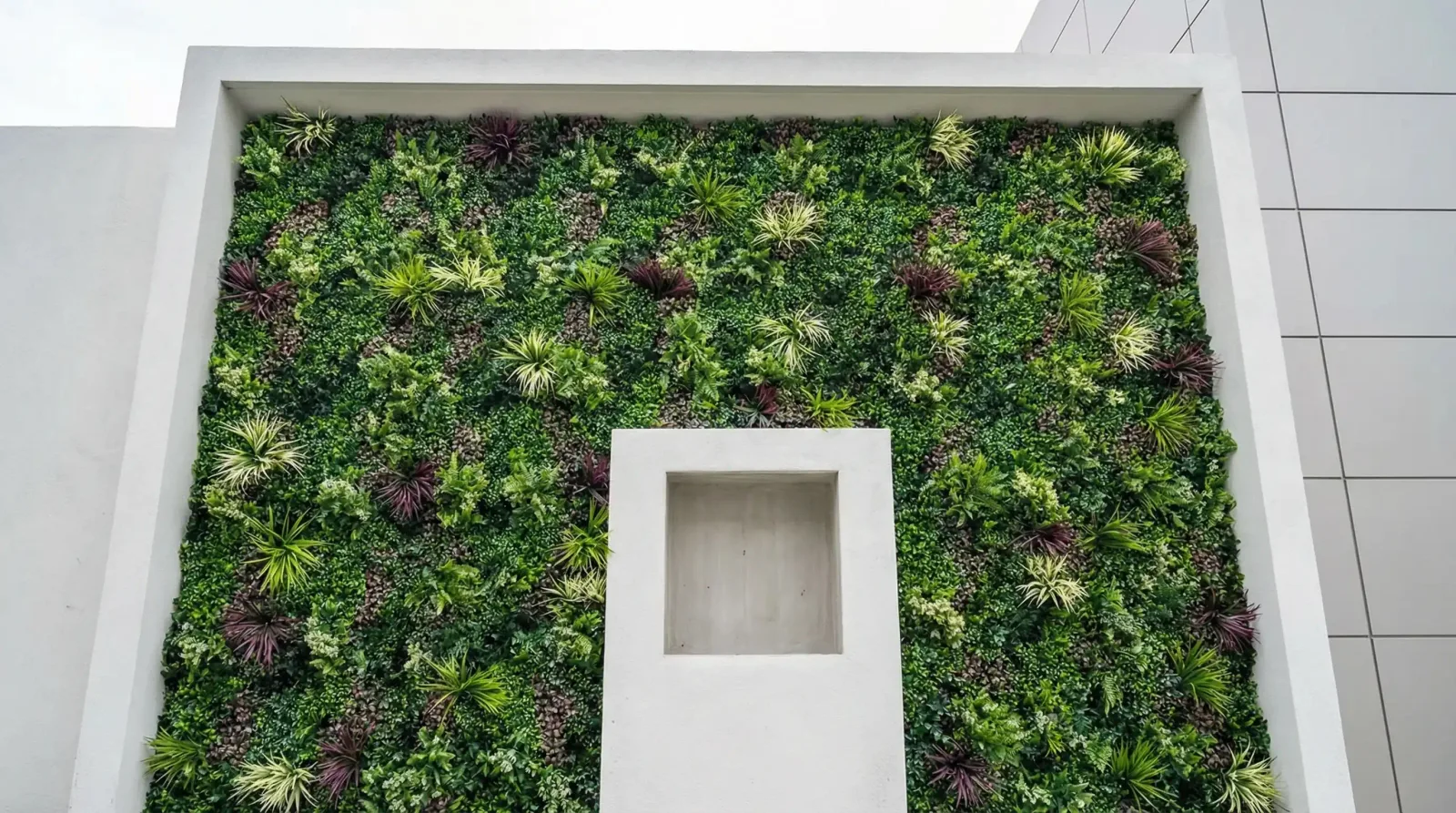
Mixed-Use
Feature-wall and edge-screening systems for enclosed courtyard zones.
Courtyard programs often seek greenery impact in areas where irrigation access and sunlight can be inconsistent.
Quick answer
This solution page explains how to add visual depth and privacy to courtyards using artificial systems while preserving access and serviceability.
Challenge profile
Enclosed courtyards can feel flat or underutilized when vegetation planning is constrained by access and maintenance logistics.
Approach
We combine vertical greenery, privacy breaks, and focal surfaces to create layered depth while keeping service access practical.
At a glance
This solution page explains how to add visual depth and privacy to courtyards using artificial systems while preserving access and serviceability.
Expected outcomes
Can add stronger visual depth in enclosed courtyard layouts
May improve spatial identity for tenants and visitors
Often supports lower recurring maintenance planning in selected zones
Scope considerations
Sightline strategy should account for upper-level windows and walkways.
Material color temperature should be tested under actual courtyard lighting.
Access pathways for periodic cleaning should be retained in every phase.
Planning detail
Courtyard work often seems simple because the footprint is contained, but the design decisions are usually more visible precisely because the space is compact. Every wall, return, planter edge, and seating zone gets seen from close range. That means the greenery system has to do more than fill a blank surface. It has to support circulation, create a stronger sense of finish, and make the courtyard feel intentional without making it look smaller.
Artificial landscaping can be especially useful in courtyards where irrigation is awkward, service access is limited, or the property wants more control over how the finished edge reads. On mixed-use, hospitality, and residential projects, that often means deciding which wall should carry the visual weight, where privacy matters most, and whether the space needs a feature wall, a softer hedge edge, or a more controlled screen.
Planning detail
The best courtyard scopes are usually the ones that respect the size of the space. A dense feature wall can elevate the courtyard when it is applied to the right surface, but too much vertical coverage can make the room feel busy. In the same way, a privacy system can improve comfort if it screens a key view, but it can also make a compact space feel boxed in if it is overused. The planning conversation should stay focused on which surfaces need the most help and which ones should stay quieter.
From an ownership standpoint, courtyards also reward low-maintenance solutions because they are so visible. A wall with dead patches or uneven live growth will undermine the whole space quickly. That is why a carefully specified artificial system can be the better long-term move when the goal is a courtyard that stays composed through changing seasons, occupancy, and maintenance cycles.
Related courtyard-style project
This project is worth reviewing because it shows how Califauxscapes handles compact or highly visible spaces where one wall or edge can change how the whole courtyard reads.
CalifauxScapes installed a 200 sq ft UV-resistant, irrigation-free Vallum FRX artificial living wall in a Los Angeles multi-family courtyard. One-day install, low maintenance, immediate visual upgrade.
Open case studyDecision framework
Courtyard decisions usually turn on whether the main goal is atmosphere, privacy, or visual cleanup of a weak edge. Those are related goals, but they often point to different systems.
Best when the courtyard needs a focal point or a vertical surface that gives the space more identity.
If the main issue is privacy between adjacent uses, a privacy screen usually solves more directly.
Best when the courtyard needs softer separation and a more garden-like feel.
If the space is very compact, a privacy wall may use the footprint more efficiently.
Best when the courtyard needs controlled separation or cleaner geometry.
If the design wants a more planted aesthetic, hedges or selective living wall coverage will feel less rigid.
Recommended products
Supporting projects
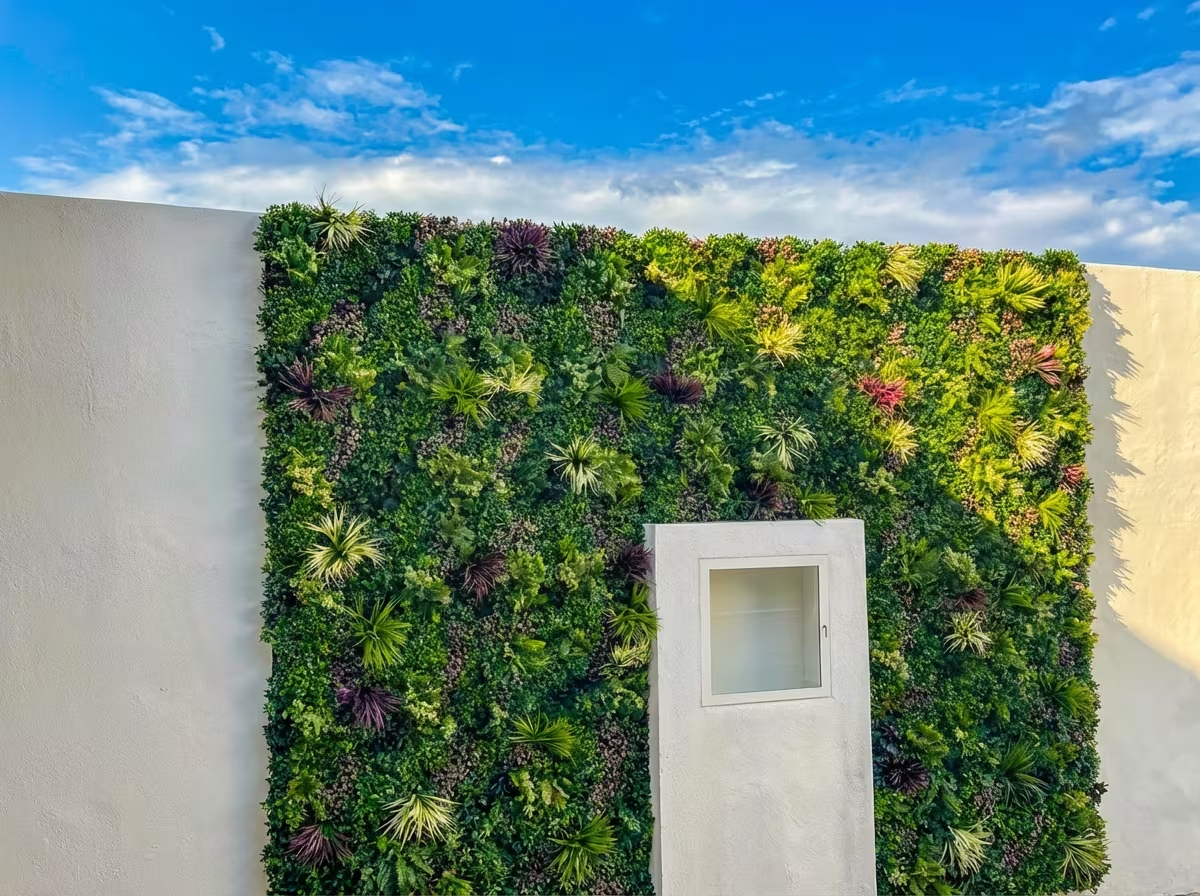
Los Angeles
CalifauxScapes installed a 200 sq ft UV-resistant, irrigation-free Vallum FRX artificial living wall in a Los Angeles multi-family courtyard. One-day install, low maintenance, immediate visual upgrade.
Open case study
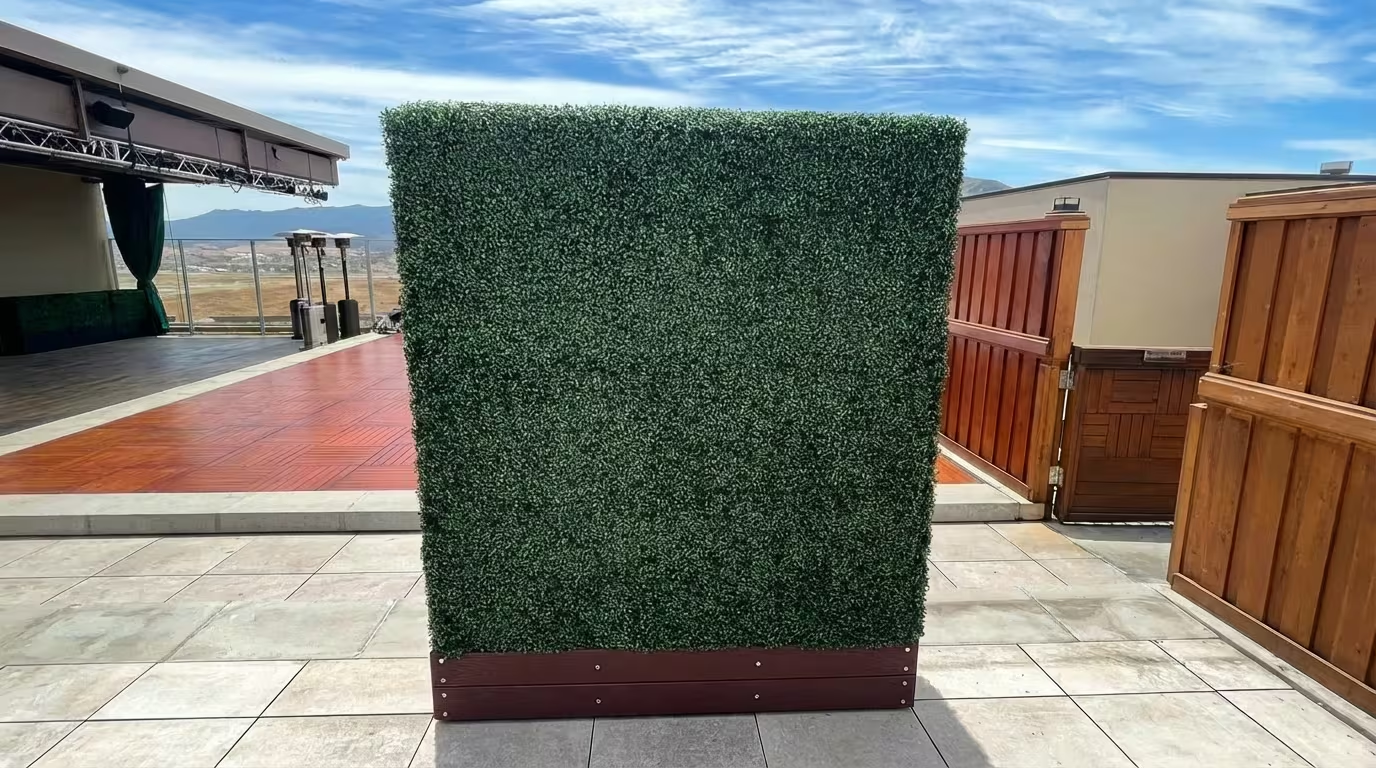
Jamul
CalifauxScapes replaced failing outdoor hedges at a Jamul casino with UV-stabilized artificial boxwood hedge panels on a custom composite wood base, built for exterior conditions and instant privacy.
Open case study
Related resources
A strong option when the courtyard needs a more dramatic focal wall.
Useful when softer screening is the better design move.
Helpful where separation and tighter control matter more than softness.
More detailed planning context for courtyard wall applications.
Explore next
FAQ
Yes, many courtyard scopes combine focal greenery and screening elements, depending on circulation and sightline priorities.
Design usually starts with a hierarchy: one primary focal element, then supporting screens and transitions.
Artificial systems can often be useful in low-light courtyards where live planting performance is inconsistent.
Yes, many courtyard projects are phased to align with occupancy and budget planning.
Coverage
5-year limited UV warranty on qualifying products and 1-year installation workmanship warranty.
Coverage is limited and subject to product eligibility, installation scope, and written warranty terms.
5-year limited UV
1-year installation
Written terms apply