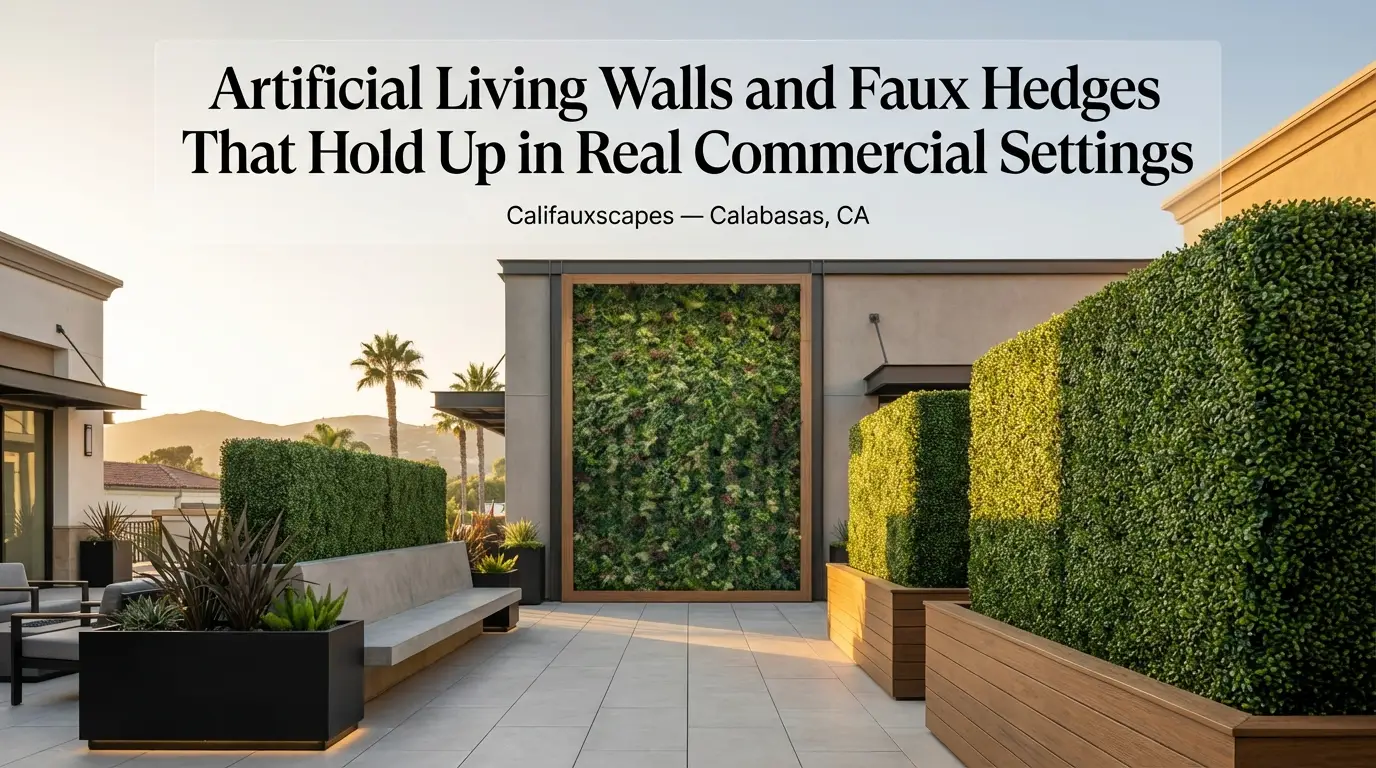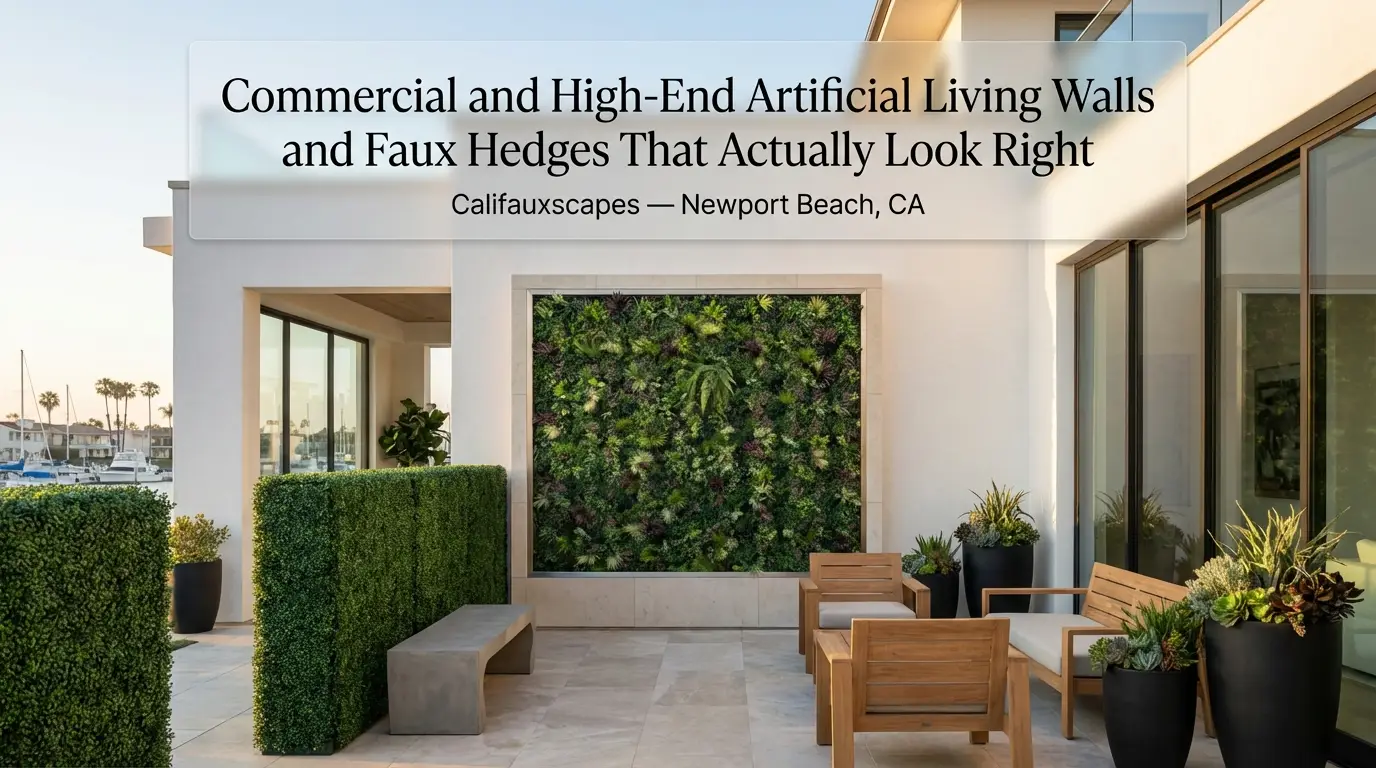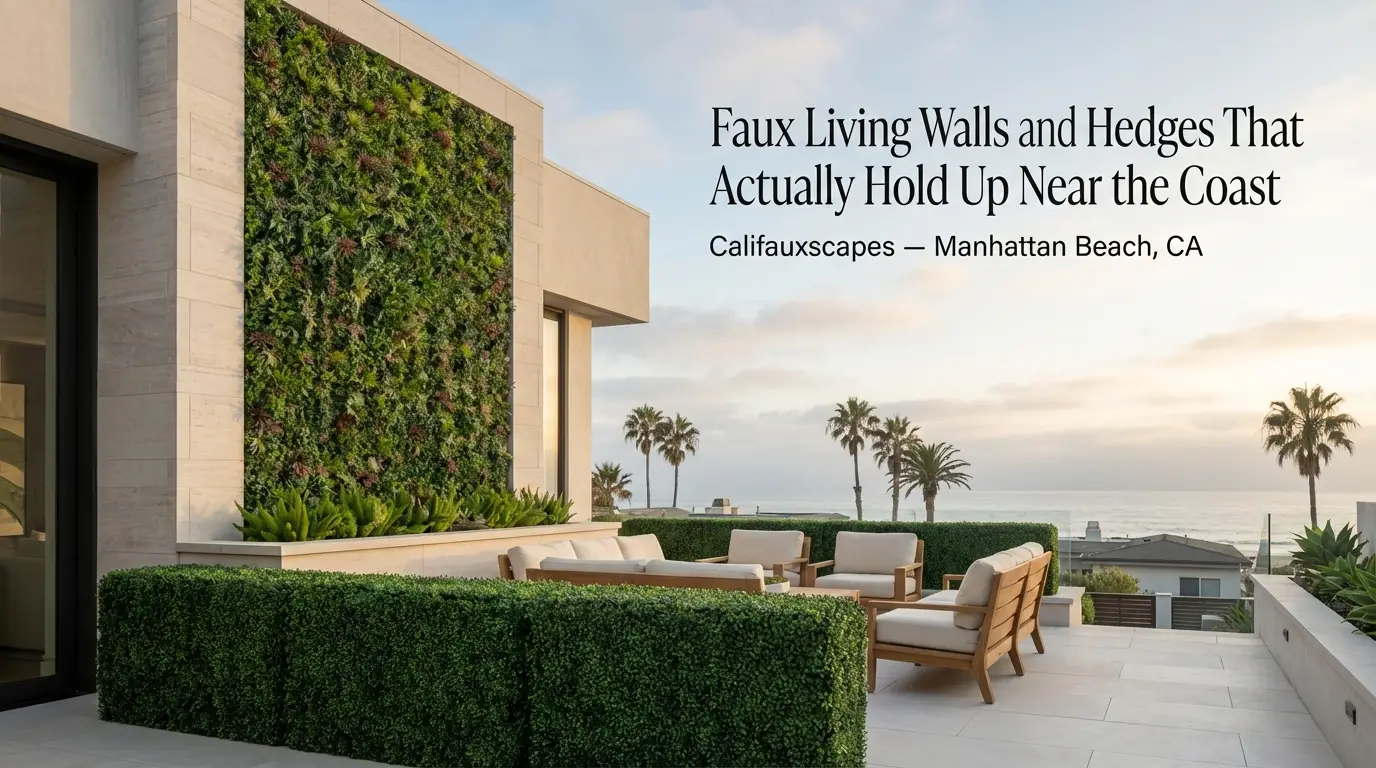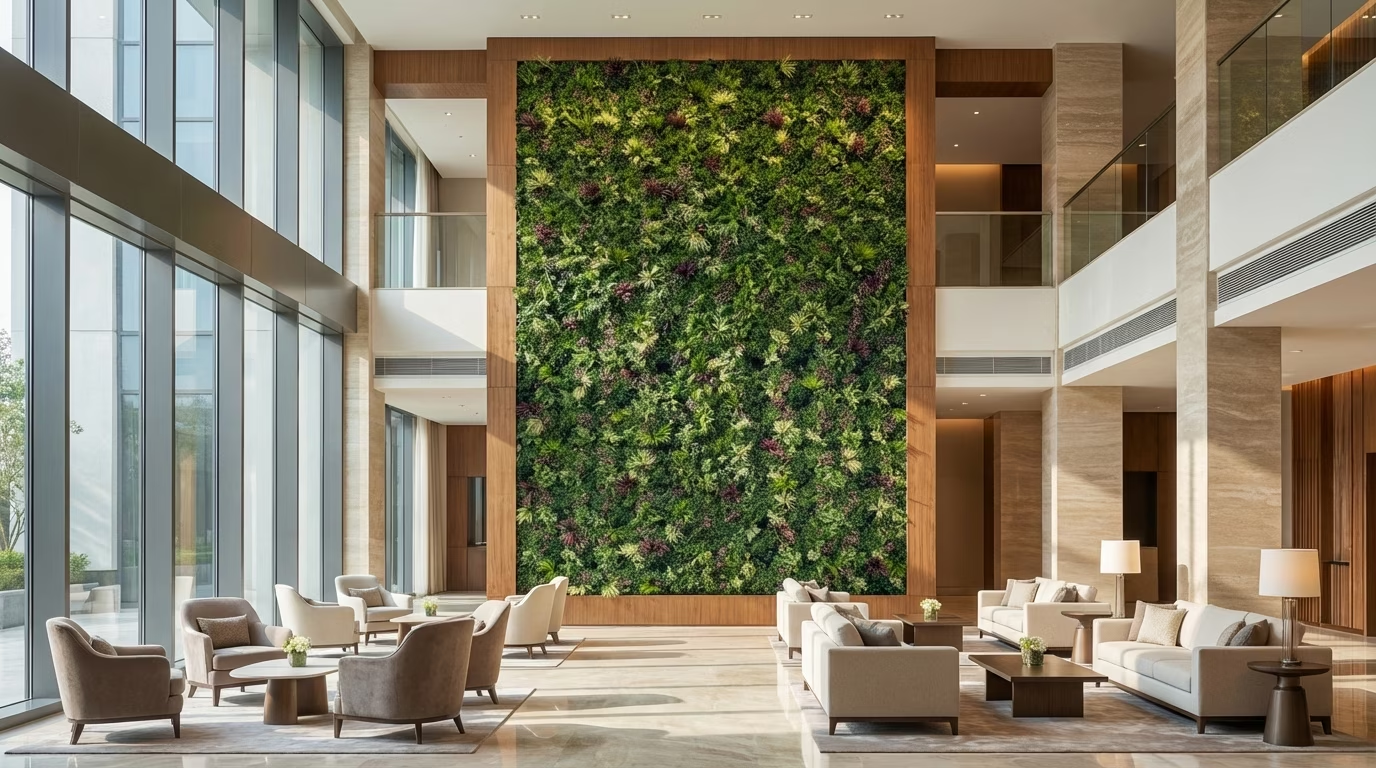
If you manage a lobby on University Avenue, a courtyard near California Avenue, or a home in Old Palo Alto, you’ve probably hit the same wall: you want greenery that looks real from five feet away, but you don’t want to deal with irrigation leaks, constant plant swaps, pests, or a sad-looking wall by late summer.
Califauxscapes works in Palo Alto, CA on commercial and high end, artificial living walls, and artificial hedges. in Palo Alto—including artificial living walls, faux living walls, fire rated living walls, faux hedges, and fake hedges. Below is what usually looks right (and what reads cheap fast), what to ask before you hire anyone, and a few Palo Alto-specific details that can keep approvals and installs from dragging out.
The local artificial greenery scene in Palo Alto (and why it’s not the same as “anywhere in the Bay”)
Palo Alto is picky in a way that actually affects the outcome. Your lobby might sit next to $30M+ real estate, tenants notice finishes, and plenty of visitors have enough design literacy to clock plastic leaves from across the room.
You also get a wide mix of property types in a small radius. Downtown offices near University Avenue usually want clean, modern moves: a vertical green feature behind reception, or hedging to soften hard patio edges. Along California Avenue, it tends to be more pedestrian and hospitality-leaning—screening a service zone or wrapping an outdoor dining edge without making the street feel closed off. Then there are residential pockets like Crescent Park and Old Palo Alto, where the ask is usually: “Make it feel natural. Don’t make it shiny. And please don’t make it look like we ordered it online.”
There’s a practical side that comes up on Palo Alto jobs too:
Indoor planting sounds great until you price the day-to-day realities—grow lights, drainage, water treatment, leak risk, and regular plant replacement. Living walls can be done well, but they’re a living system. Faux living walls aren’t. They’re basically a finish material.
And on commercial projects, decisions are often shared. A property manager wants low maintenance. A designer wants a very specific green. An owner wants fire performance and clean documentation for the file. That’s usually when a specialist like Califauxscapes gets pulled in instead of a general “we do plants” vendor.
Why Palo Alto property owners and managers choose artificial living walls and faux hedges
Most clients don’t open with “I want a faux living wall.” They describe the constraint first.
They want the look, not the irrigation problems
If you’ve ever chased a slow leak behind a finished wall, you already get it. Interior living walls need irrigation, drainage, and access for maintenance. In a lobby, that can turn into tear-outs when something goes wrong. A properly built artificial living wall skips water entirely, so you can put it where a living system would be risky—near millwork, behind a reception desk, or on a finished corridor wall.
They need consistent visuals year-round
Palo Alto’s climate is mild, but “mild” still includes plant stress. Outdoor planters deal with heat spikes, wind exposure, irrigation restrictions, and uneven shade. Indoors, plants change based on light levels and HVAC.
With faux living walls and fake hedges, the goal is simple: the same density in September as in February, with no brown spots in the places people actually look.
They’re managing labor and access on commercial properties
Commercial landscape maintenance adds up, and some areas are just hard to service: rooftop terraces, upper-level courtyards, tight side yards, or spaces that need security access.
Faux hedges make sense when you want screening but don’t want crews trimming every few weeks or dragging green waste through common areas.
They’re thinking about materials and fire documentation
Not every project needs a fire rated living wall, but once you’re inside commercial buildings (or near assembly areas, egress routes, or interior finish requirements), it comes up.
The plain-English version: many jurisdictions reference ASTM E84 (surface burning characteristics). “E84 Class A” is often what people mean when they say “fire rated” for interior finish materials. But what gets accepted depends on your AHJ (Authority Having Jurisdiction) and the exact use. Some projects need documentation for the product itself, and some need it for the assembled system.
Califauxscapes can help you sort out what your Palo Alto project actually needs—and what’s just someone guessing.
What to look for in a Palo Alto artificial living wall or faux hedge provider
There’s no shortage of faux greenery products. Most are designed to sell online. That’s not the same thing as looking right in a Palo Alto lobby or a high-end courtyard.
Start with the “read” from different distances
A wall that looks fine on a product page can look flat in person. In Palo Alto commercial spaces, people don’t just glance at it—they walk up to it while checking in, waiting for an elevator, or sitting in the lobby. Your wall has to hold up at:
- 15–20 feet (overall pattern and color tone)
- 6–10 feet (depth and shadow)
- 2–3 feet (leaf shape, sheen, and repeat patterns)
If a provider can’t explain how they avoid repeating tiles, overly glossy leaves, or that one-note “all the same green” look, you’re rolling the dice.
Ask how the system is built, not just what it looks like
With artificial living walls, you’re not just buying greenery. You’re buying an installed finish. That includes:
- Substrate and mounting approach (what’s going into drywall vs. concrete vs. exterior sheathing)
- Seams and corner details (where cheap installs usually give themselves away)
- Edge transitions (how it meets ceilings, trim, and lighting)
- Access strategy (if something needs adjustment later)
Install details matter more in Palo Alto because the spaces are already finished. You might be mounting to painted Level 5 walls, stone, wood slats, or architectural panels. It needs to look intentional—not like something got stuck up at the end of the job.
Get clarity on “fire rated” and what paperwork you’ll receive
If you need a fire rated living wall (or you think you might), don’t accept fuzzy answers. Ask:
- Is the product tested to ASTM E84? If so, what class?
- Is the rating for the facing material only, or for the full assembly?
- Do you provide the test report and spec sheet for the submittal package?
And a reality check: compliance can vary by jurisdiction and inspector, even within the same county. In Palo Alto, confirm requirements with the local AHJ (Authority Having Jurisdiction) for your specific permit scope.
Look for a provider who understands commercial scheduling
In Palo Alto, a lot of work has to fit around tenant hours, deliveries, and limited staging—especially near downtown corridors.
A good provider will ask early about:
- Work windows (after-hours vs. daytime)
- Noise constraints (drilling into concrete at 7am rarely goes over well)
- Protection (flooring, millwork, and nearby finishes)
- Disposal plan (packaging and off-cuts)
This is where Califauxscapes typically shows up like a trade partner, not a decor seller.
Palo Alto-specific considerations that affect design, approvals, and longevity
Sun and glare are real issues on outdoor installs
Even with Palo Alto’s relatively mild weather, exterior faux hedges can take a beating if they’re stuck in harsh, reflective conditions—bright afternoon sun bouncing off glass or light stucco in a courtyard.
If your site sits near large glazed elevations (common on newer offices and mixed-use), ask about UV stability and where fading shows up first. Good faux greenery shouldn’t go chalky or brittle after a short stretch outdoors.
Wind exposure in courtyards and breezeways
A lightly attached faux hedge can “drum” or flex in the wind, especially in breezeways between buildings. In mid-block passages near University Avenue or open courtyards around larger office footprints, secure attachment and a rigid backing system make a difference.
Cleanability (because Palo Alto dust is a thing)
Palo Alto gets dust and pollen like the rest of the Peninsula—especially in the dry months. Indoors, HVAC can also leave dust sitting on flatter leaf surfaces.
Ask what cleaning looks like in plain terms. Vacuum and microfiber? Compressed air? A periodic wipe-down? If the answer is “it never needs cleaning,” that’s not realistic for a public-facing space.
Code and documentation: don’t guess
If your project involves tenant improvements, common-area remodels, or anything that triggers plan check, material documentation can save you weeks.
Use the right words in meetings: you’re not asking for something “fireproof.” You’re asking whether it’s fire-resistant and whether it has an ASTM E84 rating your AHJ will accept.
And one more disclaimer worth saying plainly: fire ratings and compliance vary by jurisdiction—always confirm requirements with your local AHJ (Authority Having Jurisdiction).
Where Palo Alto style tends to land
In neighborhoods like Crescent Park and Old Palo Alto, the walls and hedges that usually work best are:
- Slightly muted greens (less neon)
- Mixed leaf sizes (helps kill the “tile” look)
- Enough depth to cast shadow (flat panels read fake fast)
Downtown commercial spaces often land better with cleaner textures and tighter patterns—as long as the finish quality is there.
Getting started with Califauxscapes in Palo Alto
If you’re planning a faux living wall or faux hedge in Palo Alto, the simplest way to keep things moving is to gather a few specifics before you ask for a proposal.
You’ll get to answers faster if you can share:
- Approximate wall or hedge dimensions (height x width). Even rough numbers help.
- Location type: interior lobby, exterior courtyard, rooftop, breezeway, etc.
- Substrate: drywall, concrete, stucco, wood slats, metal framing.
- Whether you need fire rated living walls documentation for a submittal.
- A couple of reference photos showing the look you want (not to copy—just to set the tone).
From there, Califauxscapes can steer you on material selection, panel layout (to avoid obvious repeats), corner/edge details, and what to prep on-site so the install doesn’t turn into a patch-and-paint saga.
If you’re coordinating with a designer, GC, or property manager, decide early who owns approvals and who owns the finish scope. Faux greenery is “decor” until it’s permanently mounted—then it’s part of the build.
Conclusion: a Palo Alto look without the Palo Alto maintenance schedule
Palo Alto clients usually want greenery that feels calm and intentional—not loud or plasticky. Getting there takes the right product and an install that matches the architecture.
If you’re searching for Califauxscapes in Palo Alto, CA for commercial and high end, artificial living walls, and artificial hedges. Palo Alto CA, start with what you’re trying to solve—maintenance, consistency, fire documentation, or privacy screening—and work backward to the right system.
When you’re ready, contact Califauxscapes to talk through your site, your finish expectations, and whether you need artificial living walls, faux living walls, fire rated living walls, faux hedges, or fake hedges for your Palo Alto property.
FAQ (real questions we hear in Palo Alto)
How long do artificial living walls last indoors?
Indoors, they usually last far longer than outdoor installs because UV exposure is lower. How long is “long” comes down to product quality, how much direct sun it gets near windows, and how often it’s cleaned.
Can a faux living wall be installed on textured walls or concrete?
Usually, yes. The mounting method changes with the substrate. Concrete and stucco often need different anchors and more planning than drywall.
What does “fire rated living wall” actually mean?
Most people mean an ASTM E84 rating for surface burning characteristics (often “Class A”). But acceptance depends on your project and your AHJ (Authority Having Jurisdiction). Ask for the actual test documentation.
Do fake hedges look obviously fake up close?
They can—especially if they’re glossy, too uniform, or installed in a way that exposes seams. Better systems use varied leaf shapes, deeper layering, and cleaner edge detailing.
Are faux hedges okay outdoors in Palo Alto?
They can be, but placement matters. Full afternoon sun, reflective glass, and wind exposure can shorten their visual life. Ask about UV stability and attachment methods for your specific courtyard or rooftop.