If you manage a property or own a high-end home in Newport Beach, you’ve probably hit the same snag: you want greenery that looks finished year-round, without dealing with irrigation leaks, salt-air burn, or nonstop trimming.
That’s where Califauxscapes comes in. Califauxscapes designs and installs commercial and high end, artificial living walls, and artificial hedges. in Newport Beach—including artificial living walls, faux living walls, fire rated living walls, faux hedges, and fake hedges built to handle coastal Orange County conditions.
In this guide, you’ll see where artificial greenery tends to get used around Newport Beach, why it often beats live plantings in certain spots, what to ask before you approve an install, and how local realities (salt air, sun, wind, and jurisdiction rules) affect the spec.
The local artificial living wall and faux hedge scene in Newport Beach
Newport Beach has a pretty specific aesthetic—clean lines, curated landscaping, outdoor spaces that look planned. But coastal conditions (and normal, busy schedules) can turn “simple” landscaping into a lot of upkeep.
You’ll most often spot artificial living walls and fake hedges in a few kinds of places:
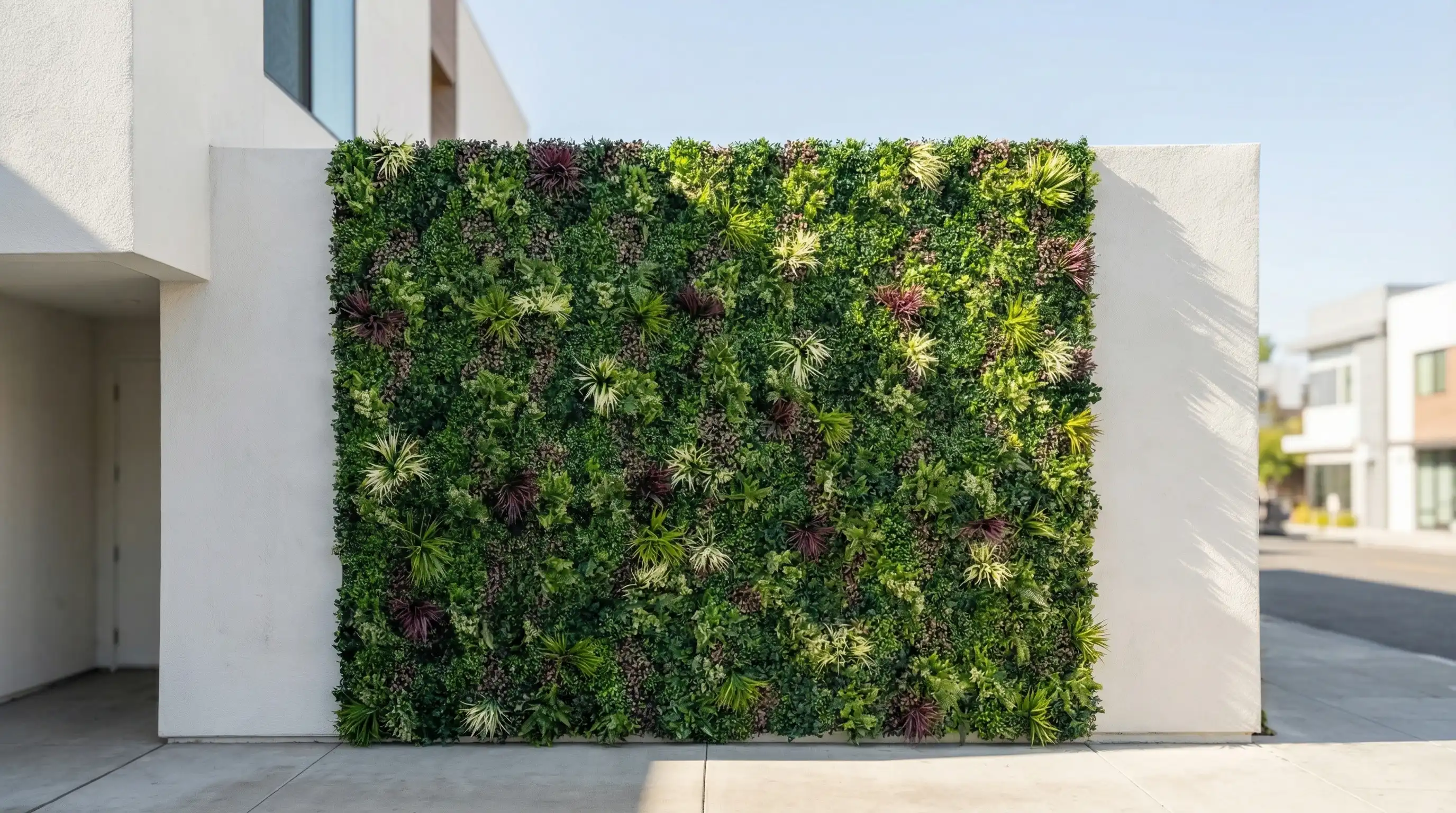
In Fashion Island, retail and restaurant frontage often uses greenery as a backdrop for signage, patio seating, and photo walls. Live vines and hedges can look great, but keeping them consistently full is work. When one section thins out, browns, or gets pests, the whole wall starts to look patchy. A faux living wall sidesteps that uneven cycle.
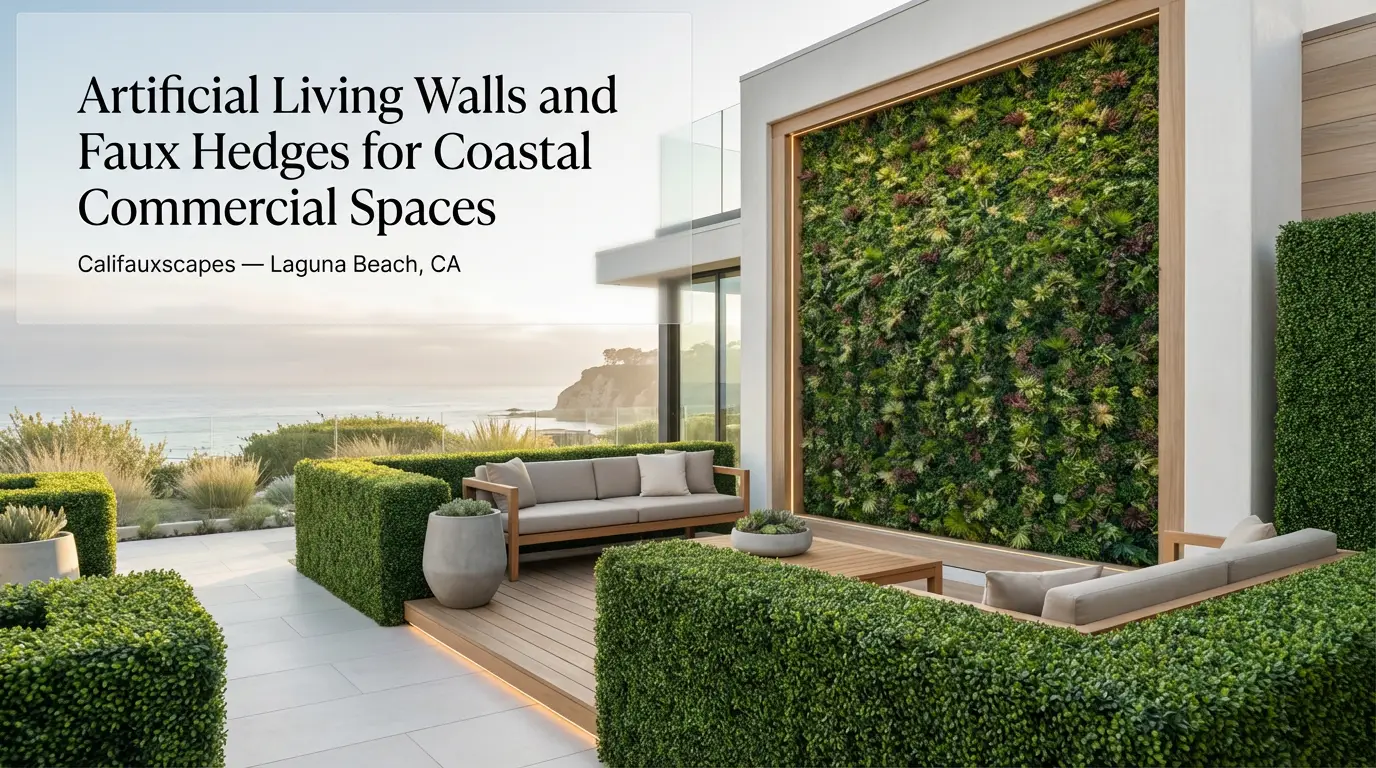
Around Balboa Peninsula, space is tighter and the wind and salt exposure are more intense. Live screens can struggle unless someone is constantly babysitting them. A faux hedge can work as a privacy panel on a patio or rooftop edge without relying on planters that crack, leak, or stain.
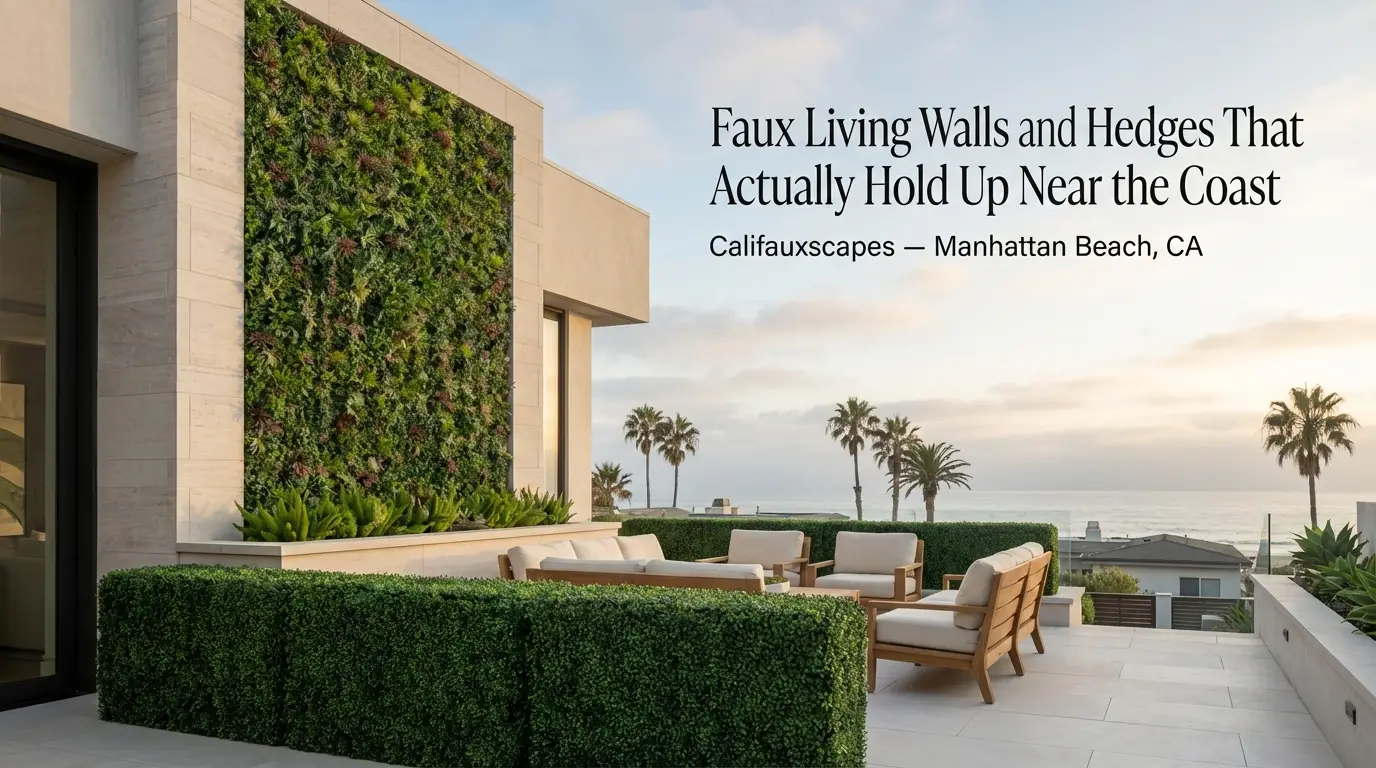
In Corona del Mar, where curb appeal is always under a microscope and a lot of homes lean modern with hardscape, artificial hedges often get used to soften walls or add privacy without running irrigation near foundations. It’s not just “less maintenance.” It’s tighter control over where water ends up.
Newport Beach also has plenty of HOAs and professionally managed communities. A lot of them want green screening and privacy, but they also want predictable results and fewer landscape vendor visits. Artificial hedges and artificial living walls are easier to standardize across units because the color and density don’t drift week to week.
One more local wrinkle: fire standards and material questions come up a lot in building conversations across Southern California. If you’re considering fire rated living walls, you’ll want to separate a sales phrase from actual documentation. A provider should be able to explain how the product was tested (for example, ASTM E84, which measures surface burning characteristics). Whether you need a specific rating depends on your AHJ (Authority Having Jurisdiction) and the exact use case (interior, exterior, egress paths, commercial lobby walls, etc.).
Why Newport Beach property owners choose artificial living walls and faux hedges
Most people don’t choose faux greenery because they “don’t like plants.” They choose it because they’re done dealing with the same problems over and over.
You can’t control coastal wear on live plants
Newport Beach’s weather is pleasant, but salt air and wind can be rough on certain plantings. Leaves burn. Growth thins out on the windward side. And close to the water, you can end up replacing sections just to keep a wall looking even.
Artificial living walls don’t run through that cycle. What you see in February is basically what you’ll see in August, which matters when your property gets photographed all year.
Water management matters more than people admit
A living wall that depends on irrigation can be a headache in the wrong spot. Not because water is “bad,” but because it finds weak points: behind stucco, along electrical runs, into planter seams, under pavers. On commercial sites, even a small leak can turn into slip risk or finish damage.
A faux living wall gives you the green surface without hiding irrigation behind a façade. For a lot of Newport Beach projects, that’s the deciding factor.
Privacy without waiting for growth
One reason faux hedges get picked is simple: you want privacy now, not a year and a half from now.
If you’re blocking a neighbor’s second-story view, covering a service area, or carving out separation on a patio, a fake hedge gives instant coverage. That comes up a lot on tighter Balboa Peninsula lots and in courtyard-style layouts around Newport Coast-adjacent communities.
Cleaner results for commercial branding
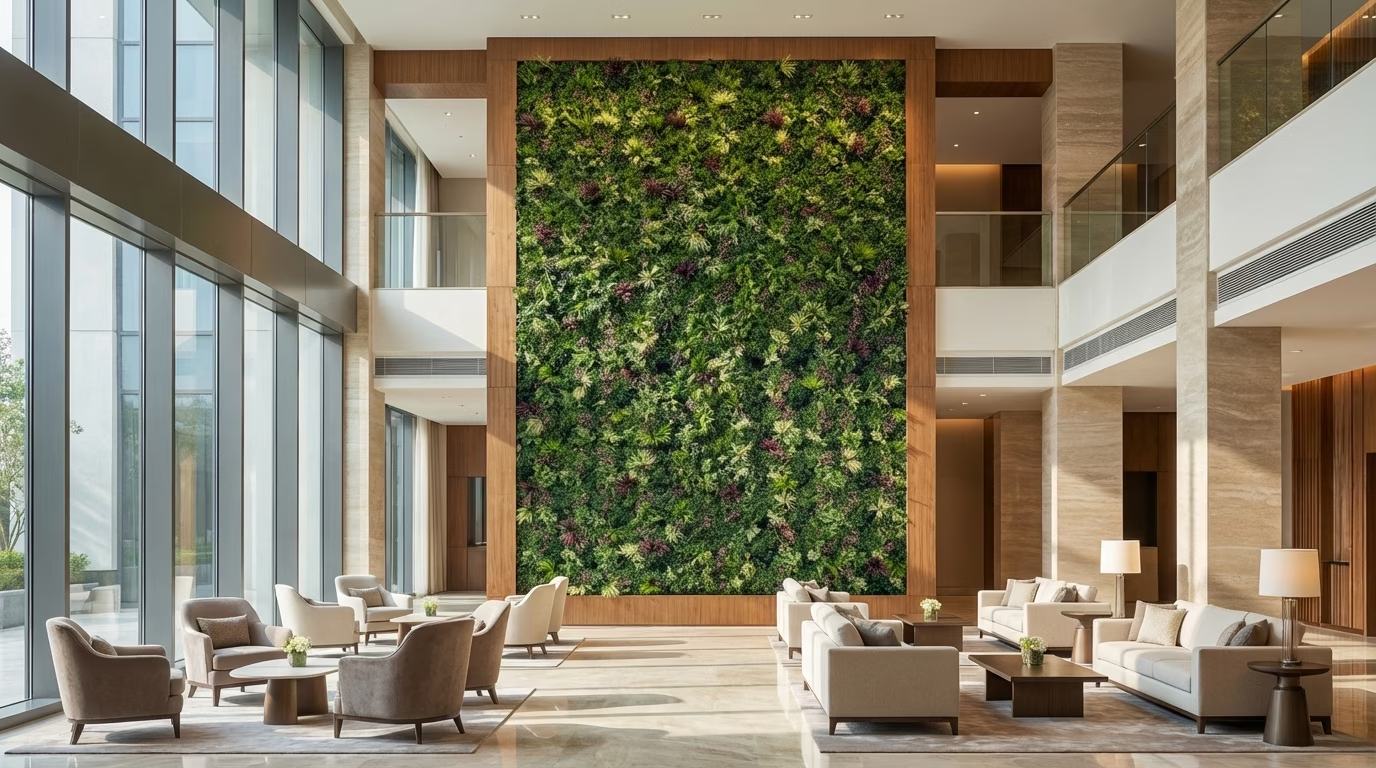
For commercial properties—restaurants, med spas, office lobbies—green walls often end up functioning like part of the brand. That means you need consistent density, color, and edges. Live plantings can be great, but they don’t stay perfectly even without steady labor.
An artificial living wall is basically a finish material. It behaves more like architectural cladding than “landscaping,” which is why it fits controlled design work.
Fire rating questions aren’t going away
If you’re specifying anything foliage-like on a building—especially inside commercial spaces—you’re going to get fire performance questions. “Fire rated living walls” should come with paperwork, not a one-line claim.
A practical way to think about it:
If it’s going into a commercial interior (lobby feature wall, tenant improvement, hospitality space), you may be asked for an ASTM E84 rating (often discussed as a Class A/B/C result). What’s required depends on the use and local interpretation.
If it’s exterior, you can still get questions about flame spread, ember exposure, and how close the wall is to structures. California defensible space concepts (including Zone 0, the 0–5 foot zone next to structures in state guidance) often come up in Southern California, but what’s enforceable depends on your location and the codes being applied. Always confirm with your local AHJ.
Califauxscapes is used to these conversations. The aim is straightforward: choose materials that fit the application and can be backed up with documentation.
What to look for in a Newport Beach artificial living wall or faux hedge provider
A green wall that looks good in a showroom photo is easy. A wall that still looks good after a year of sun, wind, and real-world use is where the specs matter.
Start with materials that match the install location
Ask what the base panels are made from and how they’re attached. On exterior installs, hardware matters because Newport Beach air can be tough on metals.
You don’t need a chemistry lecture, but you do want clear answers:
Is it UV stabilized for Southern California sun?
Is it intended for indoor-only use, or rated for exterior exposure?
What does the backing system look like at corners and edges?
If a section gets damaged, can it be replaced without tearing down the entire wall?
If you’re installing in a high-touch area (restaurant patio, retail entry), ask about durability and how it holds up to repeated contact.
Don’t accept “fire rated” without paperwork
If someone says a faux living wall is “fire rated,” get that definition in writing.
In many commercial situations, you’re looking for ASTM E84 test results and a stated classification (often discussed as Class A, B, or C). Some products use flame-retardant treatments; others use different base materials.
Two honest notes that are worth saying plainly:
-
Fire ratings and compliance vary by jurisdiction and application—your local AHJ makes the call.
-
A product being tested doesn’t automatically mean your exact installation is approved. Egress paths, sprinkler coverage, and other design details can change what’s allowed.
Califauxscapes can help you pull the documentation you may need for plan check or property management files, but it’s still smart to confirm expectations early.
Look at how they handle seams, corners, and terminations
In Newport Beach, green walls often function as feature finishes. People stand close. They touch them. They take photos next to them.
Seams should be tight.
Corners should look intentional.
Terminations should have a clean border solution—especially where the wall meets stone, plaster, wood slats, or signage.
If a provider only shows wide shots, ask for close-ups. A good installer won’t hesitate to show detail photos.
Ask where it’s being installed: substrate and waterproofing matter
A faux living wall still needs the right substrate. Whether it’s going onto stucco, concrete, tile, or a framed wall, the fastening method should match the surface.
For exterior installs, ask how penetrations are handled and whether an air gap or drainage detail is part of the system. Even without irrigation, Newport Beach still gets marine layer moisture, occasional heavy rain, and wash-downs on commercial sites.
Confirm maintenance expectations (yes, there is some)
Artificial doesn’t mean “never touch it.” In Newport Beach, dust and salt can build up.
A realistic plan is usually periodic rinsing or low-pressure washing (depending on location), plus spot cleaning as needed. If the wall sits under a restaurant canopy, talk about grease exposure and cleaning methods that won’t break down the material.
A provider should be able to tell you what cleaners to avoid and how to keep the wall looking even over time.
Newport Beach-specific considerations that change the spec
This is where a lot of generic blog content falls apart. Newport Beach isn’t Palm Springs, and it isn’t inland Irvine.
Salt air and marine layer
If you’re closer to the water—near Balboa Pier areas, the peninsula, or along the bay—you’re dealing with salt exposure. That affects hardware choice and long-term appearance.
It’s a big reason exterior-rated materials and corrosion-resistant fasteners matter more here than they might a few miles inland.
Sun angles and fading
Newport Beach gets bright sun, and exterior walls can take a beating depending on orientation. A south- or west-facing wall near an open patio can be in constant exposure.
UV-stabilized materials and good color blending are what keep an artificial living wall from looking faded or washed out.
Wind loading and attachment strategy
The closer you are to open coastal wind, the more you need to think like a builder, not a decorator.
A big faux hedge wall can act like a sail. Attachment spacing, backing rigidity, and edge detailing matter. That’s especially true on larger commercial installs and rooftop or upper-level applications.
Local permitting, HOAs, and who approves what
Newport Beach projects often run through one of three approval tracks:
A commercial property manager who needs documentation and a clean scope.
An HOA review that cares about visible changes and consistency.
A building department plan check if the work triggers permits (varies a lot by scope).
If fire performance documentation is part of the requirement—common in commercial interiors—start that conversation early. It’s much easier to choose the right fire rated living wall product up front than to swap materials after design approval.
And it’s worth repeating: fire ratings and compliance vary by jurisdiction. Your AHJ decides what’s acceptable for your location and use.
Real-world local data point: water isn’t cheap
In Orange County, water can be expensive compared to what many people grew up paying, and rates shift by agency and tiered use. For properties that irrigate heavily, cutting irrigation demand can be a budgeting decision, not just a design preference.
If you’re trying to reduce irrigation complexity (especially on commercial sites with multiple controllers, planters, and drip lines), faux hedges and artificial living walls can be one piece of a broader water-management plan.
Getting started with artificial living walls and faux hedges in Newport Beach
If you want this to be painless, treat it like choosing a finish and scoping an install—not like a casual landscaping add-on.
Start by taking a few photos of the area and writing down basic dimensions. Then get clear on what the wall needs to do: privacy, a branding backdrop, covering an unattractive surface, or creating a consistent look where live plants keep failing.
From there, Califauxscapes will usually walk you through material options based on location (interior vs exterior), sun exposure, and whether documentation like ASTM E84 results might be requested.
If you’re in a neighborhood with HOA review—common around Newport Coast-adjacent communities and planned developments—pull together whatever submittal packet they ask for. That often means product photos, a materials description, and an install drawing showing placement.
And if you’re coordinating with a commercial GC or property manager near places like Fashion Island or along Pacific Coast Highway corridors, align early on schedule and access (lift needs, off-hours work, tenant coordination). Those details usually decide whether the job is smooth or a headache.
Conclusion: Califauxscapes for Newport Beach projects that need a clean, consistent finish
If you’re searching for Califauxscapes in Newport Beach, CA, you’re probably not after a generic green wall. You want something that holds up close, stands up to coastal conditions, and comes with documentation when a property manager, designer, or inspector asks for it.
Califauxscapes designs and installs commercial and high end, artificial living walls, and artificial hedges. Newport Beach CA projects with that in mind—materials, attachment details, and (when needed) fire performance paperwork.
If you’re ready, call (858) 525-2251 or send photos and rough dimensions so we can recommend an approach that fits your site in Newport Beach.
FAQ
Are artificial living walls okay outdoors in Newport Beach?
Yes—if the product is meant for exterior exposure and the attachment method matches the substrate. Newport Beach sun, wind, and salt air aren’t forgiving, so an indoor-only panel shouldn’t be treated like exterior cladding.
What does “fire rated living wall” actually mean?
Usually it means the product has test documentation for a fire standard such as ASTM E84 (surface burning characteristics). What you need depends on the application and your AHJ (Authority Having Jurisdiction). Ask for the actual report and confirm requirements early.
Do faux hedges fade in California sun?
They can if they aren’t UV stabilized or if the material quality is low. On south- and west-facing walls in Newport Beach, sun exposure is intense, so the spec matters.
How do you clean a faux living wall near the coast?
Most exterior walls do fine with periodic rinsing and gentle cleaning. Avoid harsh solvents unless the manufacturer allows them. If the wall is near food service, talk through grease exposure and cleaning frequency.
Can Califauxscapes match a specific look for a designer or HOA?
Usually, yes. The easiest way is to start with a reference photo, confirm color, leaf size, and density, then make sure seams and edge details are handled cleanly so it doesn’t read like “panels on a wall.”