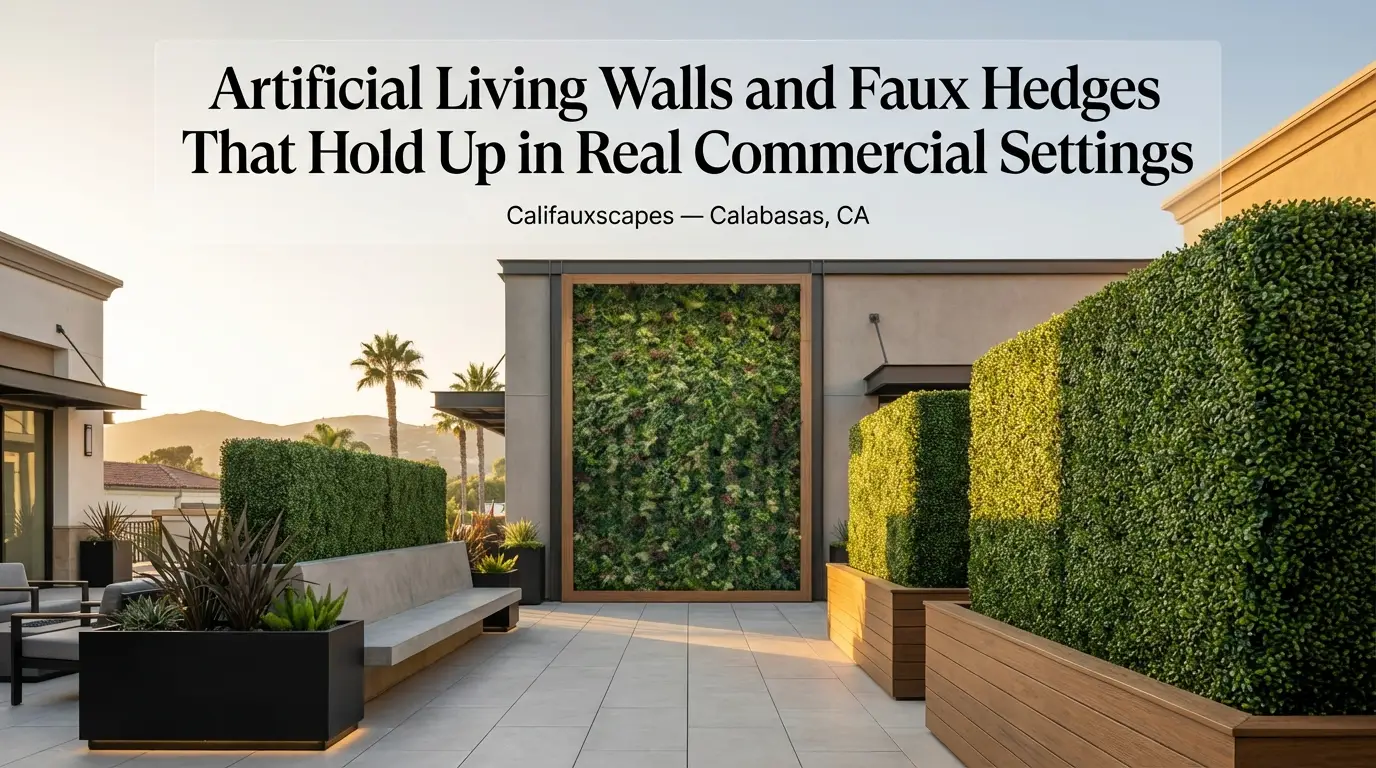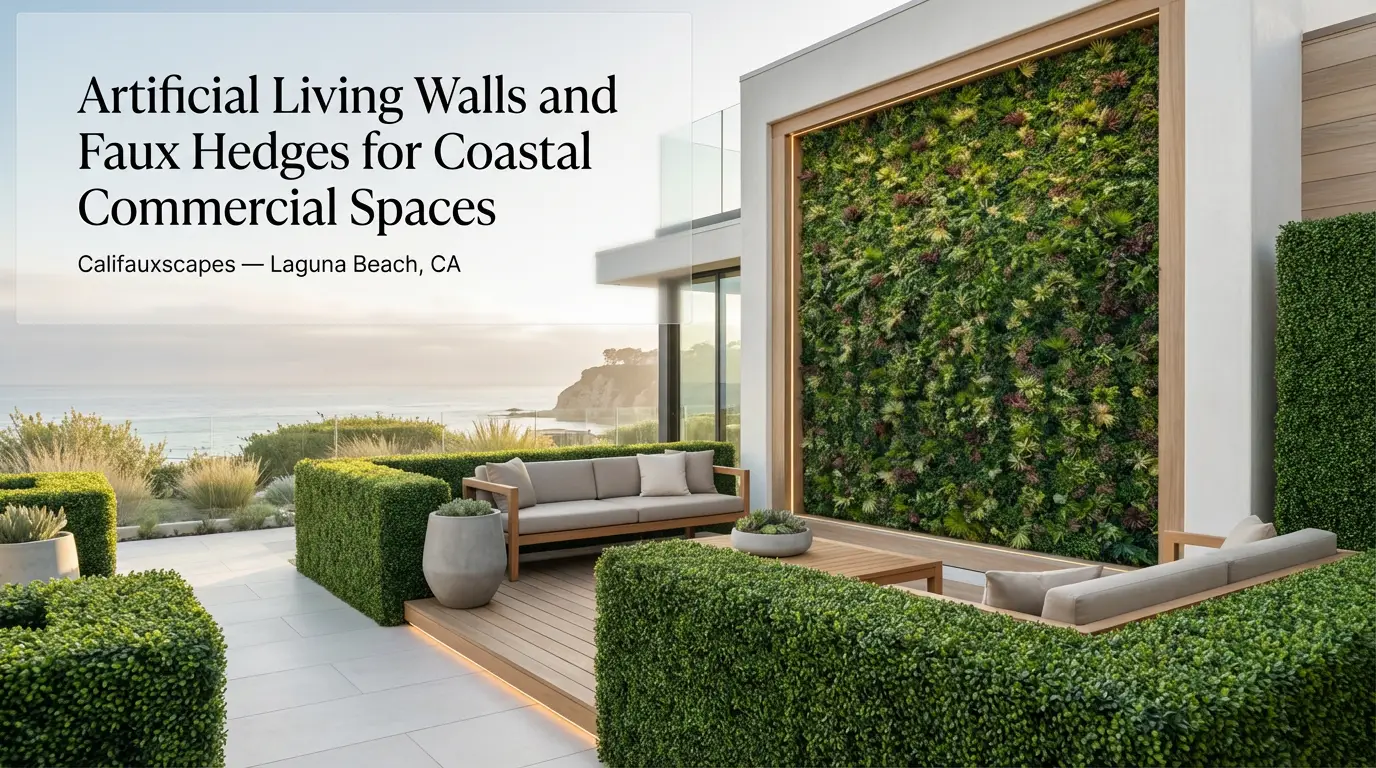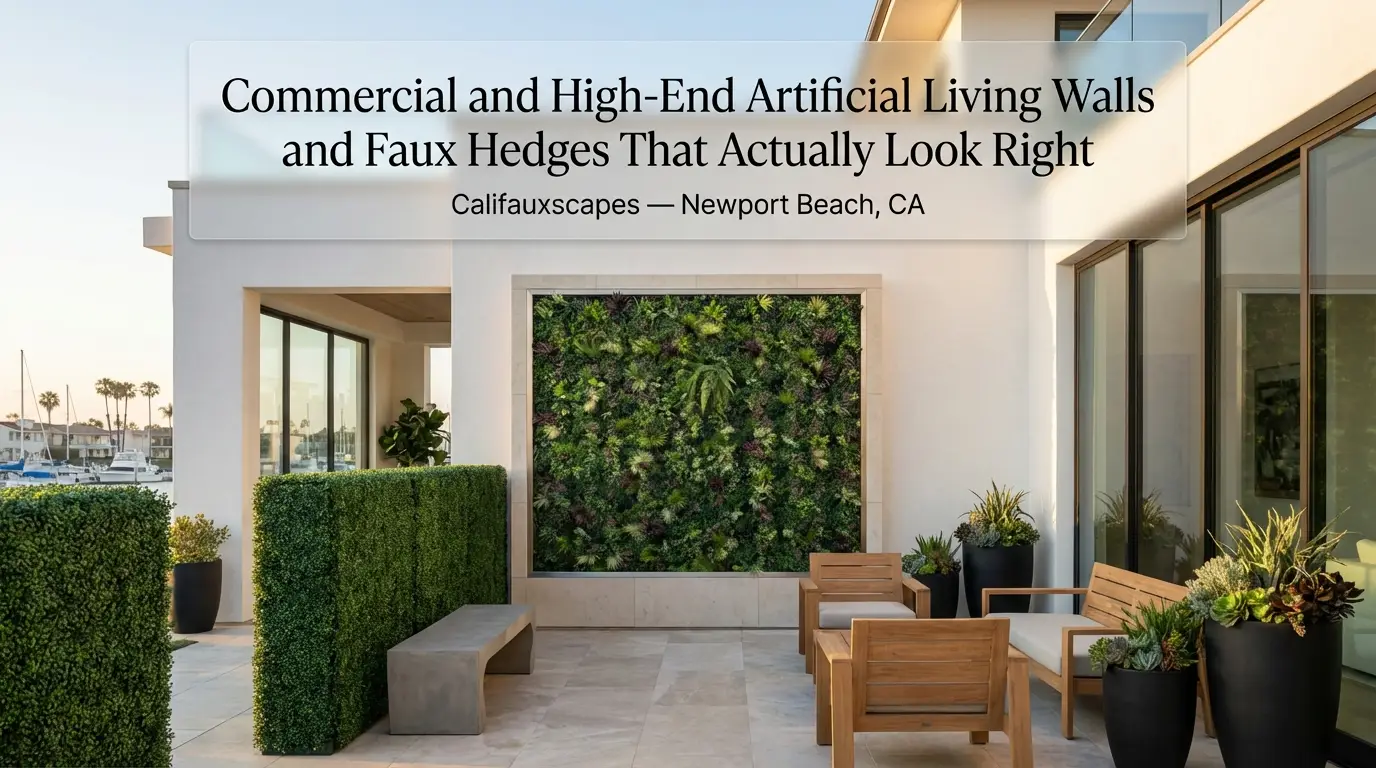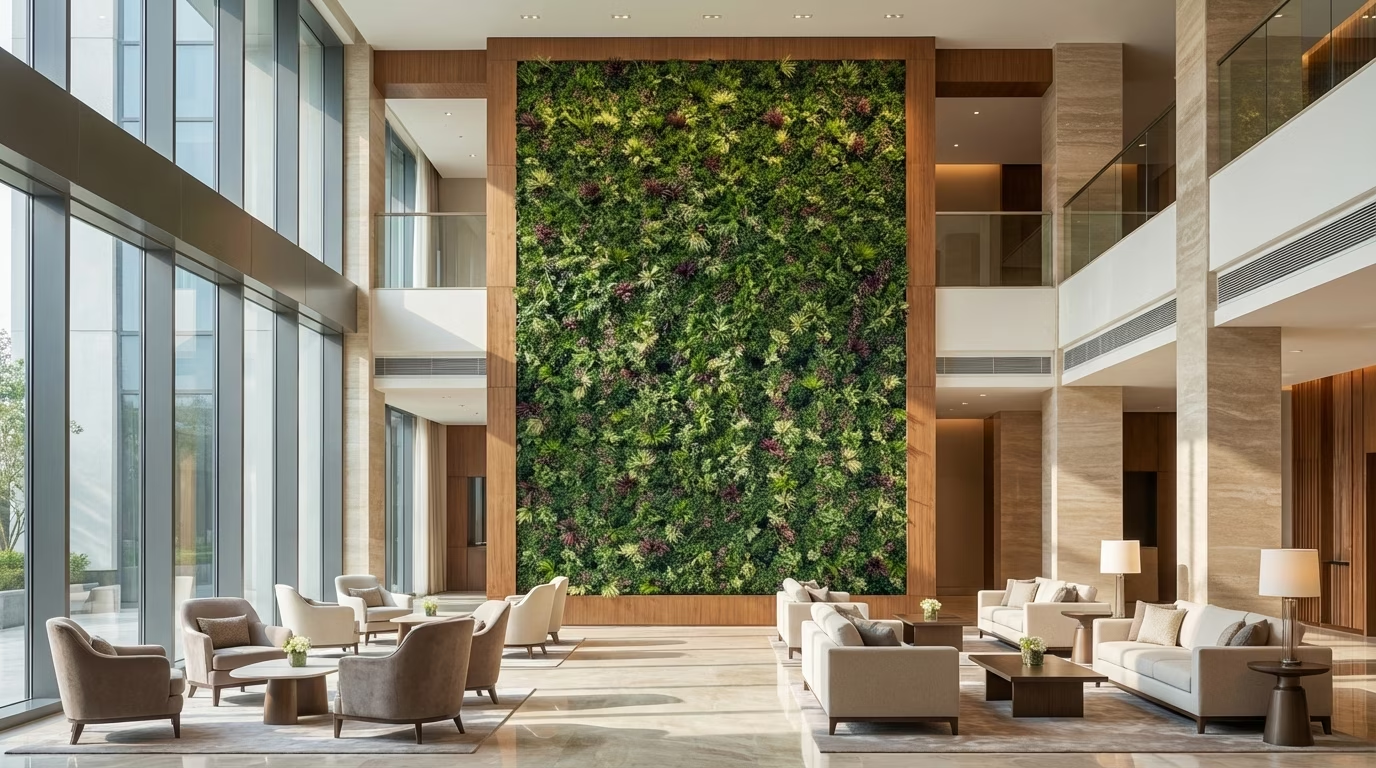
If you manage a commercial property or own a high-end home in Manhattan Beach, CA, you’ve probably hit the same snag: you want greenery that looks intentional all year, but you don’t want irrigation lines, nonstop trimming, or plants that get wrecked by salty air. That’s where Califauxscapes fits—commercial and high end artificial living walls and artificial hedges in Manhattan Beach—built for real installs, not just staged photos.
In this guide, we’ll get into what tends to work here (and what tends to fail quickly), how to think about fire-rated materials, and what to ask before a contractor mounts anything to your exterior wall, rooftop deck, or storefront façade.
The local “green wall” situation in Manhattan Beach (and why it’s different)
Manhattan Beach has a particular mix of design expectations and environmental wear. The Strand and the walk streets set a tough standard visually. Downtown Manhattan Beach around Manhattan Beach Blvd and Highland Ave is packed with restaurants, retail, and small commercial buildings where curb appeal matters, but maintenance crews are usually thin. And in neighborhoods like Sand Section, Tree Section, and East Manhattan, outdoor areas are often tight—side yards, small patios, rooftop decks—so every surface has to justify itself.
Living walls can look great, but in coastal Los Angeles County they also come with the same recurring problems: irrigation leaks behind the system, mineral buildup, plants that struggle in wind, and ongoing horticulture costs. Artificial living walls (also called faux living walls) cut out the irrigation and replacement cycle, so property managers aren’t constantly dealing with dead patches.
But Manhattan Beach still isn’t “set it and forget it.” Salt air and strong sun speed up wear. Even when the weather feels mild, UV exposure stacks up, especially on west- and south-facing elevations. That’s why the material spec matters more than the Pinterest photo.
You’ll also see a slightly different set of use cases here than inland:
A lot of installs are about privacy screening (especially along balconies and roof decks), sound/visual buffering near busier corridors, and dressing up blank walls in small courtyards.
For commercial spaces, artificial hedges are often used as:
- Patio dividers for restaurants and cafés near downtown
- Screening for trash enclosures and service areas (where real plants usually don’t do well)
- Entry features on narrow storefronts where you want texture without giving up floor space
Califauxscapes works in this exact lane: commercial and high end installs where panel seams, mounting method, and fire-rating documentation matter as much as the look.
Why Manhattan Beach clients choose artificial living walls and faux hedges
Most people aren’t choosing faux greenery because they hate real plants. They choose it because the constraints are what they are.
You can’t always (or want to) run water
On rooftops, balconies, and exterior façades, irrigation can be a non-starter. Even a small leak can lead to drywall repairs, stucco problems, or HOA drama. Artificial living walls remove the irrigation variable. That’s a relief for property managers—and anyone who’s ever chased a mystery water stain.
Coastal sun + salt air is rough on “pretty” materials
Low-grade faux panels fade, get brittle, or start shedding. The difference usually comes down to UV stabilization and the quality of the backing. In Manhattan Beach, that’s not theoretical—your wall is probably getting sun and wind almost daily.
If you’re comparing options, ask straight up what the product is rated for outdoors and what the warranty actually covers (fading is often excluded on cheaper products).
You want privacy without the maintenance contract
Faux hedges and fake hedges are common on:
- Rooftop decks in the Sand Section
- Balconies and small rear yards in the Tree Section
- Side-yard fence lines where there isn’t enough soil volume for dense planting
Real hedges can work, but they need regular trimming, feeding, and pest control. And if they’re in planters, you’re also replacing soil and keeping an eye on irrigation emitters. Faux hedges keep the screening consistent.
Fire-rated products can matter for certain projects
Manhattan Beach doesn’t have the same wildfire profile as foothill areas, but fire performance still comes up in commercial work, multi-family buildings, and any project where an inspector or owner wants documentation.
When we say “fire rated living walls,” we’re usually talking about flame spread and smoke development test results such as ASTM E84 (often referenced for interior finish materials). You’ll hear “Class A” in this conversation. It’s not a magic shield, and it doesn’t mean a product can’t melt or deform under heat. It means it tested within a certain range under that specific standard.
What to do with that: ask for the documentation and confirm what your AHJ (Authority Having Jurisdiction) will accept for your specific installation location (interior vs exterior, egress paths, occupancy type). Requirements vary.
You want the look to stay consistent for photos and foot traffic
Manhattan Beach storefronts and hospitality spaces live and die by Google reviews and customer photos. Real greenery has off weeks. Artificial living walls keep the look steady through winter, heat waves, and the week your maintenance crew is short-staffed.
If you’re searching for Califauxscapes in Manhattan Beach, CA, that consistency is usually why you’re here.
What to look for in a Manhattan Beach provider (so you don’t redo it in a year)
A faux living wall can look great on day one and still be a bad install. In Manhattan Beach, most failures come down to mounting, seams, and product grade—not the concept.
Start with where it’s going: interior, exterior, rooftop, or fence line
An interior lobby wall by a reception desk is one thing. An exterior wall getting ocean breeze is another. Rooftops add wind load. Fence lines mean constant UV and sometimes sprinkler overspray.
A good provider will ask:
- What direction does the wall face?
- Is it full sun, partial shade, or mostly shade?
- Is it within reach of sprinklers (and will it get hard water spots)?
- Is it a public-facing commercial area that needs fire documentation?
If they don’t ask this stuff, you’re probably being sold a one-size-fits-all panel.
Ask what the backing and attachment system is
Panels are only as good as what they’re fastened to. On stucco, you need an approach that won’t crack the finish or create moisture issues. On wood or composite fencing, you need fasteners that won’t work loose over time. On metal framing, you need compatible hardware.
A Manhattan Beach-ready install plan should include:
- A clear substrate plan (stucco, CMU, wood, metal)
- Corrosion-resistant fasteners (coastal air eats cheap hardware)
- A way to avoid “oil canning” or rippling on larger runs
Seams and edges are where most walls start to look fake
The quickest tell on a low-effort faux living wall is a repeating pattern and visible panel borders. For higher-end work, you want:
- Staggered seams
- Clean edge finishing (especially around doors, windows, and returns)
- Enough variation in texture and leaf type that it doesn’t read like a grid
If the wall is going to be photographed (restaurant patios, retail entries), seam work is the job.
Fire-rated living walls: ask for the paperwork, then confirm what applies
If you need a fire rated living wall, don’t accept “it’s fireproof” (almost nothing is). Ask for:
- The test standard (commonly ASTM E84 for interior applications)
- The rating classification shown on the report (often Class A)
- The product name and batch/series info
Then confirm with your AHJ (Authority Having Jurisdiction) what they want for your use case. Some AHJs focus on egress corridors. Others care about interior finish overall. Exterior requirements can be different.
Fire ratings and compliance vary by jurisdiction—always confirm requirements with your local AHJ.
Maintenance plan: how do you clean it in a beach town?
In Manhattan Beach, you’re dealing with dust, salt residue, and sometimes soot from nearby traffic. Faux walls don’t need watering, but they do need occasional cleaning.
A provider should be able to tell you how to clean it without damaging it. For most quality panels, that’s usually a gentle rinse and light brushing—not pressure washing up close.
Manhattan Beach-specific considerations (sun, salt, wind, and the realities of small lots)
This is the part most generic blog posts skip. A few local conditions change what you should spec.
UV is the quiet killer
Even with marine layer mornings, the UV index in coastal Southern California can run high. West-facing walls near The Strand—or anywhere with open exposure—will fade cheaper plastics.
If your artificial living wall is going on an exterior that gets afternoon sun, insist on outdoor-rated, UV-stabilized materials. And ask what “outdoor rated” means in writing, not just verbally.
Salt air pushes you toward better hardware and tighter finishing
Corrosion usually shows up first on fasteners, brackets, and any exposed metal. It starts small—staining and streaks—then turns into a real maintenance issue.
In Manhattan Beach, stainless or properly coated hardware is worth the extra cost. It’s the difference between an install that still looks clean in a few years and one that leaves rust marks bleeding onto stucco.
Wind load matters on rooftops and upper floors
Rooftop decks and upper balconies in the Sand Section can get strong gusts. Large hedge panels can act like a sail if they aren’t secured correctly.
A real install plan accounts for:
- Panel size and attachment points
- The fence or railing structure it’s attaching to
- Movement at corners and ends (where panels can flap)
Commercial considerations: foot traffic and touch points
If you’re putting faux hedges around a patio in downtown Manhattan Beach, people will touch it. They’ll lean bags on it. Staff will bump it with chair legs.
That changes what “durable” means. You’ll want denser panels, stronger backing, and attachment that won’t loosen with vibration.
Fire and code conversations still come up
Even at the coast, commercial interiors and multi-family properties often have finish-material requirements. If your designer wants a faux living wall behind a host stand or in a lobby, fire rated living walls may come up during approvals.
Insurance outcomes depend on individual policies and circumstances. And code compliance depends on your specific project and what your AHJ requires.
Getting started with Califauxscapes in Manhattan Beach
If you’re trying to move from “we like the idea” to “we can approve this,” keep it straightforward.
Start by deciding what the wall or hedge needs to do: privacy, branding backdrop, hiding a utility area, or making a courtyard feel finished. Then measure the space and note sun exposure (morning vs afternoon) and whether it faces the coast.
From there, Califauxscapes can help you choose between:
- Artificial living walls for vertical feature areas and entry statements
- Faux living walls where you want dense texture with minimal depth
- Faux hedges / fake hedges for privacy screening along fences, balconies, and patios
- Fire rated living walls when documentation is needed for commercial interiors (verify acceptance with your AHJ)
If you’re coordinating with an HOA or property management team, ask for product spec sheets and install details early. That’s usually what keeps things from getting stuck.
For Manhattan Beach projects, it also helps to plan access for installation—tight side yards, limited staging space, and parking rules near downtown can affect scheduling.
Conclusion: a Manhattan Beach-ready faux wall comes down to materials and install details
A good faux living wall in Manhattan Beach doesn’t look “perfect.” It looks natural from six feet away, the seams don’t catch your eye, and it holds its color through summer sun and salty air. Califauxscapes focuses on Commercial and high end, artificial living walls, and artificial hedges. in Manhattan Beach, with options like artificial living walls, faux living walls, fire rated living walls, faux hedges, and fake hedges.
If you want to talk through an exterior wall in the Tree Section, a rooftop screen in the Sand Section, or a commercial install near Manhattan Beach Blvd, call Califauxscapes at (760) 978-7335. We’ll ask a few practical questions and point you to a spec that fits the site.
FAQ
Do faux living walls work outdoors near the ocean in Manhattan Beach? Yes—if the materials are outdoor-rated and UV-stabilized and the hardware is selected for coastal conditions. Cheaper panels usually fade and turn brittle faster in full sun.
What does “fire rated living wall” usually mean? It usually means the product was tested to a standard like ASTM E84 and has a published classification (often Class A for interior finish). It doesn’t mean “fireproof.” Acceptance depends on your AHJ (Authority Having Jurisdiction) and where the wall is installed.
Do artificial hedges hold up to wind on rooftop decks? They can, but the mounting method is what makes or breaks it. Rooftops get stronger gusts, so you want enough fastening points and a plan that keeps panels from flexing.
Will a fake hedge fade in Manhattan Beach sun? Some do. Ask for outdoor UV specs and warranty language that addresses fading. Also look at which direction the wall faces—west and south exposures are tougher.
How do you clean an artificial living wall? Most quality systems can be gently rinsed and lightly brushed. Skip aggressive pressure washing at close range—it can damage the foliage and backing.